New amendments to the Audiovisual Media Services Code, passed at first reading. The chapter on GRT is the target of criticism from the opposition
Mihaela Ciobanu
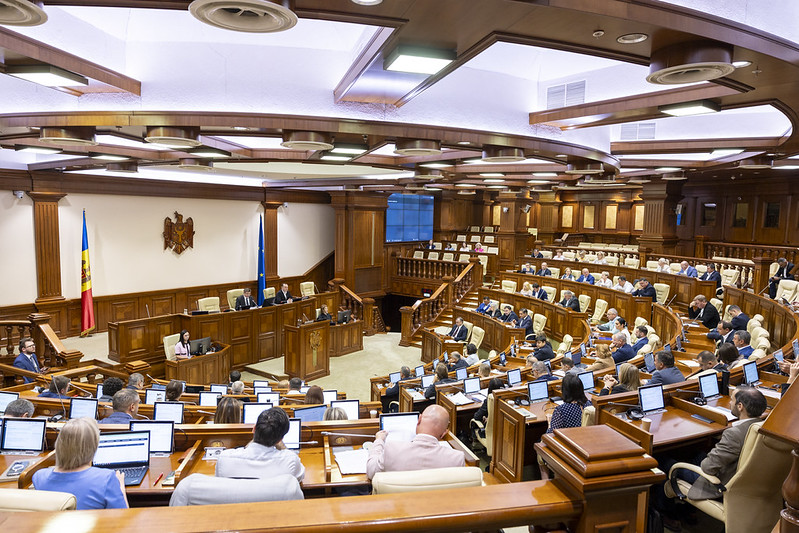
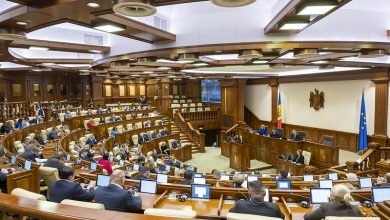
The legislative initiative providing for an increase in the proportion of programmes in Romanian and domestic productions broadcast by television stations in the Republic of Moldova was passed on Tuesday, 25 August, at first reading by Parliament. The draft amendment to the Audiovisual Media Services Code was supported by 53 MPs from the Action and Solidarity Party (PAS). The document also introduces a new chapter dedicated to the regional public media service provider in the Gagauz autonomy. This is the first time the legal framework has established its structure and mode of operation. However, the provisions concerning the appointment of the director of Gagauziya Radio Televizionu (GRT), the powers of the management committee, the composition and role of the Regional Supervisory Council, as well as the terms of reference, budget and accountability of the institution, have sparked criticism, disputes and dissatisfaction in the plenary session of Parliament.
According to the draft, television stations will be required to broadcast, between 06:00 and 24:00, at least 50 per cent of programmes in Romanian or dubbed or subtitled in Romanian. The exception applies to channels intended for communities where an ethnic minority constitutes the majority within the relevant administrative-territorial unit.
Furthermore, the document provides for an increase from 10 per cent to 20 per cent in the quota for musical works by composers and artists from the Republic of Moldova. The 30 per cent quota for works in Romanian will remain unchanged.
Previously, Media Azi reported in detail on the provisions of the initiative, including the new rules on jurisdiction, measures for better protection of minors, accessibility of media services for people with disabilities, as well as the new definitions introduced in the Audiovisual Media Services Code.
During the plenary debates, MP Liliana Nicolaescu-Onofrei noted that “the draft aims to update and harmonise the national regulatory framework with the European Union’s acquis in the field of audiovisual media services, to strengthen regulatory and supervisory mechanisms, to improve the rules on the protection of the audiovisual sector, promoting audiovisual content in the Romanian language, ensuring the accessibility of media services for people with disabilities, the protection of minors, the development of non-linear audiovisual media services, the promotion of independent European and domestic audiovisual production, as well as the regulation of the activities of the regional public media service provider”.
On the other hand, in her speech, Adela Răileanu, representative of the Party of Socialists (PSRM), criticised the frequent amendments to the Audiovisual Media Services Code. She suggested that, behind the arguments regarding the harmonisation of legislation with European standards, lay the government’s intention to silence critical voices and restrict the space for the opposition. “In the Republic of Moldova, the Audiovisual Code has come to be amended more often than the television programme schedules. Whenever the government comes up with yet another idea on how to reduce the space for the opposition, limit critical thinking and bring the media into line, it opens the Code and lets its imagination run wild,” the MP emphasised. At the same time, the MP drew attention to the new definition of disinformation, which she considers too vague and open to arbitrary interpretation. Răileanu also criticised the expansion of the powers of the Broadcasting Council. “Who decides what affects public order? Who decides where criticism ends and disinformation begins? Any journalistic piece in which an expert criticises the ‘Restart’ reform [‘Restart in Education’, ed.], an investigation into the recruitment of young people without a university degree by a political party into well-paid positions, or even a statement made by the opposition in this chamber could fall under this wording. “When concepts are so vague and open to interpretation, the law ceases to be a tool for protection and becomes a tool for exerting pressure,” she emphasised.
At the same time, Marcela Adam, an MP for the Action and Solidarity Party, highlighted three provisions she considers essential in the bill: those concerning the Romanian language, the operating rules for the regional public broadcaster, and secure strategic investments that do not jeopardise national security. “This draft bill is about more than just television channels. It is about the information that reaches citizens, the language in which it is broadcast, who can control the information and economic infrastructure, and what tools the state has at its disposal when security is threatened,” she explained.
RULES ON THE REGIONAL PUBLIC BROADCASTING PROVIDER CRITICISED BY THE OPPOSITION
According to the draft, a new chapter will be introduced into the Audiovisual Media Services Code, regulating, for the first time, the structure and mode of operation of the regional public media service provider of the Autonomous Territorial Unit of Gagauzia. The chapter sets out provisions regarding the appointment of the director, the powers of the Management Committee, the composition and role of the Regional Supervisory Board, as well as the terms of reference, budget and accountability of the institution. Thus, the members of the GRT Supervisory Board will be selected through a competition organised by the Board of Directors, and the activities of the regional public media service provider in Gagauzia will be regulated directly by the Code.
Liliana Nicolaescu-Onofrei explained that, given the amendments previously made to ensure the independence of the supervisory and management bodies of the national public broadcaster, and as similar provisions had not been introduced into the legislation of the autonomous region, the draft proposes the inclusion of this new chapter. “The operating procedures of the regional public media service provider of the Autonomous Territorial Unit of Gagauzia should be entirely consistent with the procedures set out in the national legal framework,” emphasised the chair of the parliamentary committee on the media.
Alexandr Stoianoglo, a member of the “Alternativa” parliamentary group, noted that the draft bill specifically aims to establish new rules for the GRT. In this context, he asked what purpose regional television and radio still serve if all their operating rules are laid down by organic law.
In response, Liliana Nicolaescu-Onofrei justified the need for these amendments by pointing to the harmonisation of national legislation with European legislation regarding the independence and accountability of public providers of audiovisual media services, whether national or regional.
In his speech, Stoianoglo added that he did not contest the “European aspect” of the draft law. He emphasised, however, that the European directive requires changes to broadcasting rules, not to those concerning autonomy. “And in this draft, for certain reasons, the two issues are beginning to be treated together,” the MP stated.
PSRM MP Vladimir Odnostalco also took a critical stance. He criticised the fact that neither the GRT, nor the People’s Assembly, nor the Executive Committee of Gagauzia had been involved in drafting the new regulations, and that the bill had not been discussed with the autonomous region’s authorities. The MP also drew attention to the absence of representatives from the Gagauzia authorities during the Parliament’s examination of the draft law. “This is a political issue. It concerns control over the regional public media service provider,” he emphasised.
Adela Răileanu also emphasised that the Gagauzian authorities are excluded from the process of forming and selecting the management of the regional public service provider. The MP also questioned the removal of the requirement for members of the governing bodies to know the Gagauz language.
Speaking in favour of the bill, PAS MP Marcel Spatari noted that the issue of press regulation had turned into a discussion about protecting “the interests of the fugitive oligarch Ilan Șor and the Kremlin” in Gagauzia. “It is no secret that GRT has been a platform for promoting Russian lies and disinformation in Gagauzia. (…) There is fairly solid evidence that GRT has been used in recent years to promote pro-Russian and anti-European narratives. The regional public broadcaster has amplified and broadcast propaganda and disinformation favourable to the Russian agenda,” the MP remarked in his speech.
NEGATIVE OPINION FROM GRT
GRT representatives set out their position on the matter in an opinion on the draft law, contesting the proposals. The document argues that the draft law alters the way GRT is organised and managed, including through the establishment of a regional supervisory board and the introduction of a new procedure for appointing the director. In the opinion of the authors of the opinion, however, the draft does not define the role of the Gagauzia authorities in the formation of the governing bodies clearly enough, nor does it provide for transitional rules for the transition from the current system to the proposed one.
The opinion also criticises the provisions regarding funding, language requirements and consultation with the GRT during the drafting of the bill. According to the document, the costs associated with the new management structure would be borne by the autonomy’s budget, whilst the draft does not explicitly require the director and members of the Supervisory Board to be proficient in the Gagauz language. Furthermore, the authors maintain that the GRT was not invited to the consultations organised for the drafting of the bill.
Consequently, the opinion proposes the complete removal of the provisions introducing the new chapter on the regional public media service provider.
READ ALSO: