
The cost of abusive lawsuits. What journalists lose even when they win in court
Mihaela Ciobanu
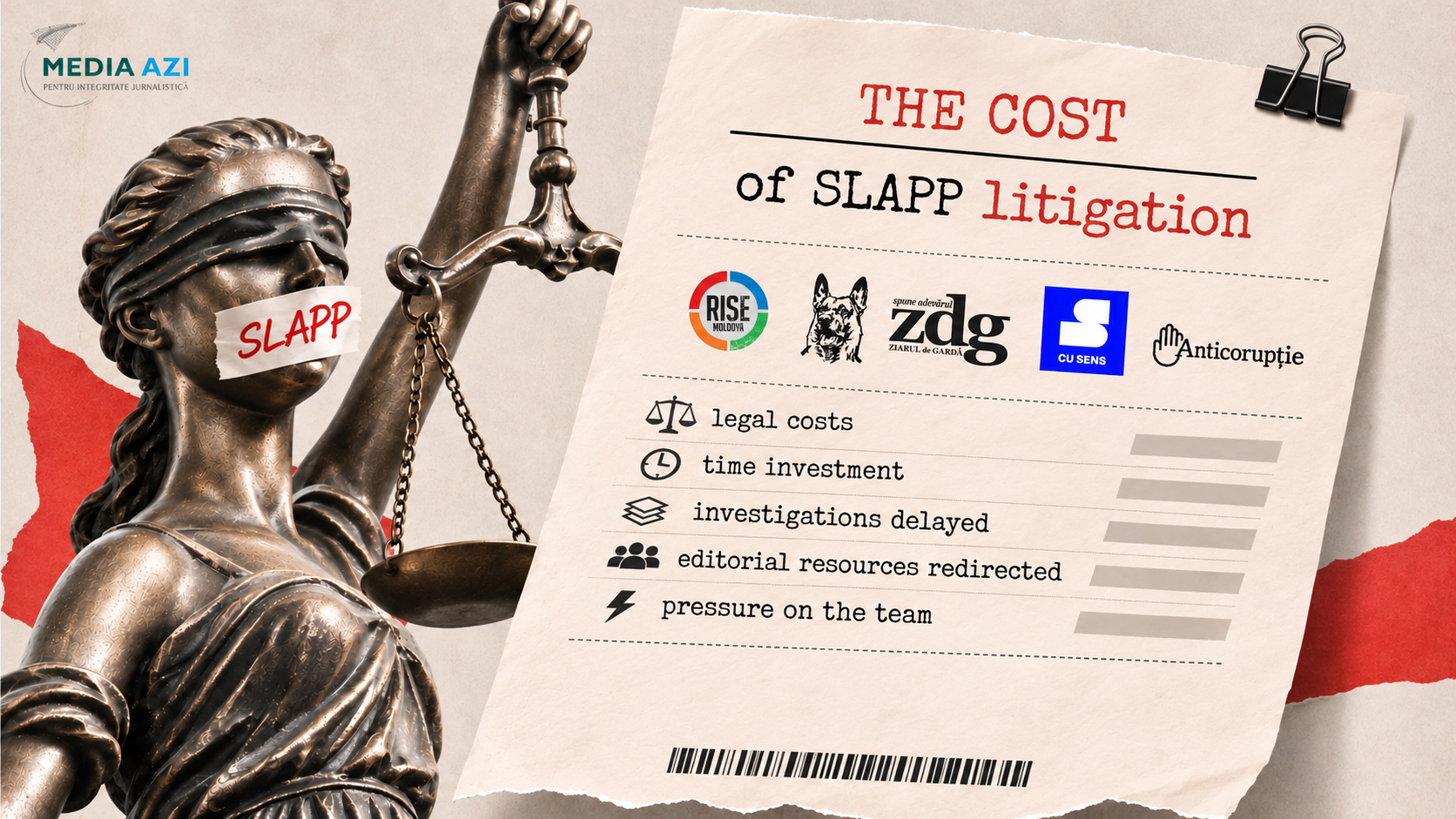
RISE Moldova paid 18,200 lei in legal fees in a court case it ultimately won in 2023. The court ordered the claimant to reimburse 12,000 lei of this amount. However, the remaining 6,200 lei represents only part of the costs incurred by the newsroom. Added to these are weeks of work dedicated to preparing the defence, financial resources redirected elsewhere and journalistic investigations that could have been carried out in the meantime. Discussions about strategic lawsuits against public participation (SLAPPs) frequently focus on the pressure exerted on journalists and the need for legal protection mechanisms. Another dimension of this phenomenon is the economic impact of such lawsuits on media outlets, including when they win their cases. Media Azi spoke to the managers of four investigative media outlets in the Republic of Moldova – RISE Moldova, Ziarul de Gardă (ZdG), CU SENS and the Centre for Investigative Journalism (CIJM) – to identify the main categories of costs generated by such lawsuits, the sources of funding used to cover them and their consequences for journalistic activity.
THE MATHEMATICS OF WINNING IN COURT
On 9 April 2021, RISE Moldova published a teaser on Facebook for an investigation conducted jointly with journalists from Romania’s RISE Project. The investigation, entitled “Casta” (The Caste), documented a cocaine trafficking network operating between Latin America and Europe, with connections in the Republic of Moldova. By the time the investigation was published on 15 July 2021, the journalistic work had already prompted two lawsuits. A third followed in August.
One of the lawsuits, filed by Eduard Tviordohleb, ended with a final ruling in favour of the newsroom in September 2023. However, the legal costs were not fully reimbursed under the court ruling.
“In the Tviordohleb case, we paid our lawyers 18,200 lei under the legal assistance agreement covering all court instances. We won the case, and the court ordered the claimant to reimburse us 12,000 lei in legal costs, so approximately 6,200 lei remained uncovered, even though we ultimately won the case,” explains Iurie Sanduța, director of RISE Moldova.
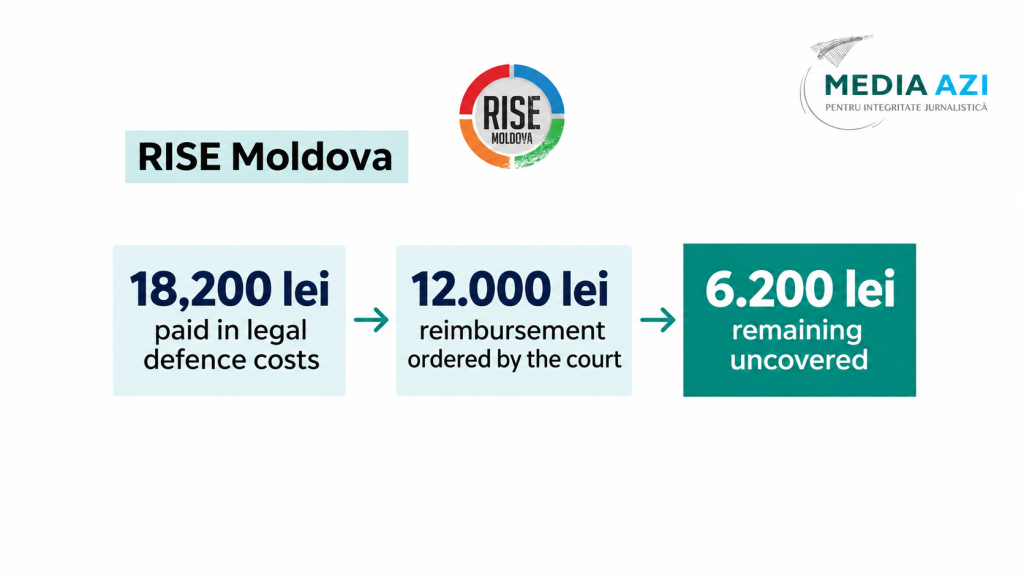
Relative to the amount paid for legal services, the difference accounts for approximately 34% of the legal costs.
RISE Moldova spent another 900 US dollars, equivalent to approximately 17,000 lei, on defending its colleagues from Romania’s RISE Project, who were sued in Chișinău by Irina Luncașu, the daughter of one of the individuals featured in the investigation. The lawsuit was dismissed.
In the third case, filed by Ilan Șor in June 2021, the newsroom received free legal assistance from the Independent Journalism Center (IJC). RISE Moldova secured favourable rulings in the court of first instance and the Court of Appeal, but the case remains pending before the Supreme Court of Justice (SCJ).
Thus, for two of the three lawsuits associated with the same journalistic investigation, RISE Moldova paid approximately 35,200 lei. This amount represents direct expenditure on legal services before deducting the compensation awarded by the court and does not include the value of the legal assistance provided by the IJC or the additional work carried out by the newsroom’s team.
TWO INVESTIGATIONS, SIX LAWSUITS, ONE MONTH
The costs of a lawsuit against the media vary depending on the length of the proceedings, the number of court instances involved and the arrangements under which legal services are contracted. According to Liuba Șevciuc, co-founder of the CU SENS media project, lawyers’ fees can range from a few hundred to several thousand euros.
For a newsroom, financial pressure increases when several individuals file separate lawsuits in connection with the same journalistic material.
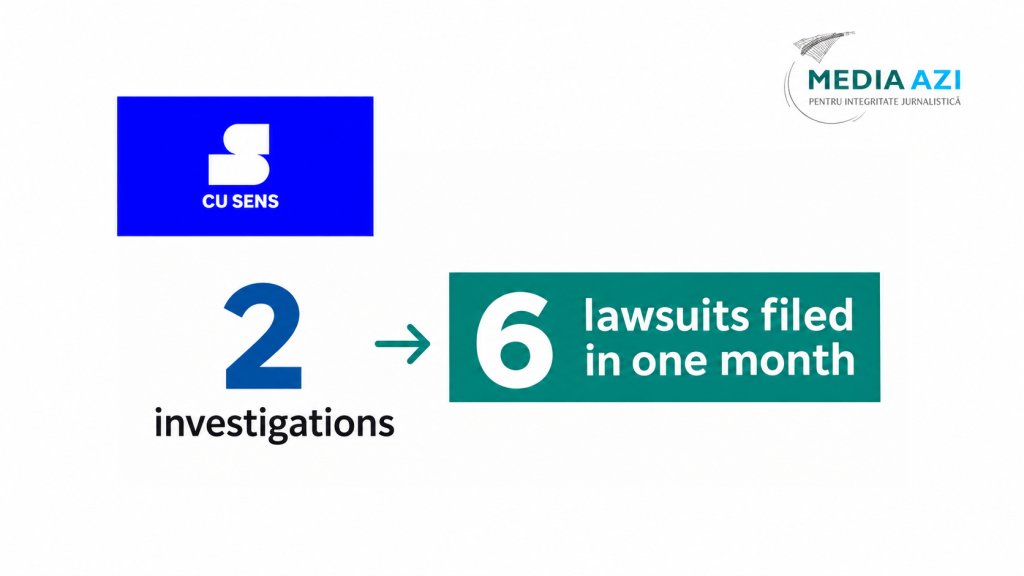
Following the publication of the investigation “Parteneriatul intereselor private” (The Partnership of Private Interests), CU SENS received four statements of claim from individuals involved in or featured in the investigation. One month later, the publication of another investigation prompted two additional lawsuits.
“So, within just one month, we found ourselves facing six lawsuits. This placed enormous financial pressure on the newsroom because, at the time, we were not prepared to deal with such a situation, nor did we have a budget allocated for this purpose,” says Liuba Șevciuc.
For one of the cases, the newsroom received financial support from the IJC. In other cases concerning the same matter, the lawyer’s fee amounted, according to the journalist’s estimates, to approximately 550 euros per case, covering representation before the court of first instance and the Court of Appeal.
During the proceedings, the newsroom had to hire another lawyer who charged per legal action rather than per case. Consequently, every court hearing attended by the lawyer and every document prepared involved a separate payment.
Under such circumstances, delays in court proceedings can also have implications for a media outlet’s budget. An adjourned hearing or an appealed ruling may generate additional costs, depending on the terms of the legal assistance agreement.
An additional challenge for newsrooms that do not have funds earmarked for litigation is securing financial resources within procedural deadlines.
“The court will not wait until you find a lawyer. You have 30 or 15 days to take certain actions. If you fail to do so, you will face the consequences later,” explains Liuba Șevciuc.
TIME THAT CANNOT BE RECOVERED
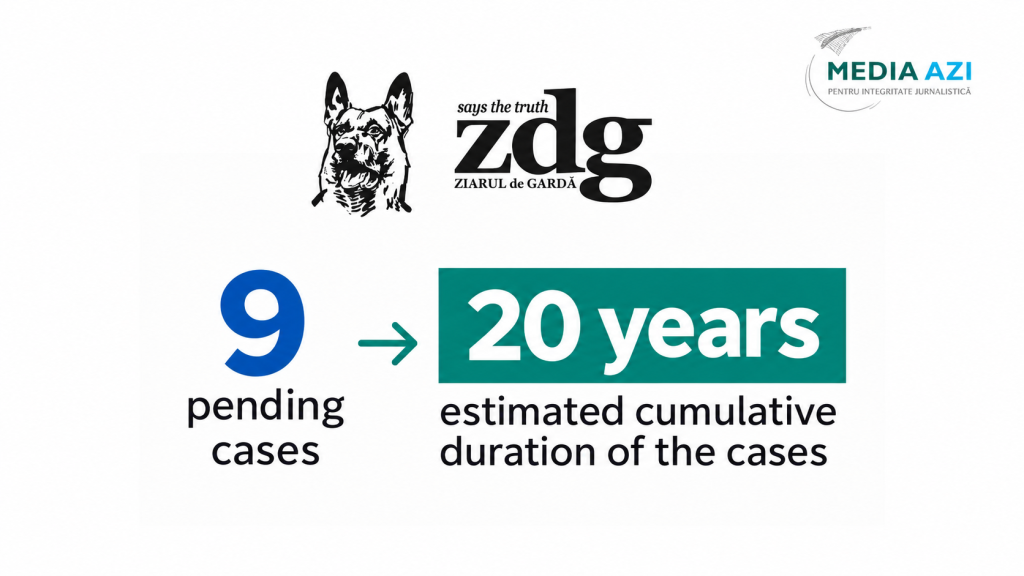
As of November 2026, Ziarul de Gardă has nine pending cases that the newsroom classifies as SLAPPs. Four are being examined by courts of first instance, another four by the Court of Appeal, and one, the oldest, by the Supreme Court of Justice.
The first of the nine lawsuits was initiated in 2021, while the most recent were filed in 2026. Taken together, the duration of these proceedings amounts to approximately 20 years, according to estimates by Alina Radu, director of Ziarul de Gardă (ZdG). This figure reflects the cumulative duration of the lawsuits, some of which are running concurrently, rather than the actual working time spent by journalists.
In addition to legal fees and court-related expenses, the ZdG director draws attention to the internal resources mobilised to manage each lawsuit. These include discussions within the editorial board, preparation of documents and coordination of the defence at every stage of the proceedings.
According to Alina Radu, in its 22 years of activity, Ziarul de Gardă has lost only one court case and won dozens of others. However, favourable outcomes have not eliminated the need to continually allocate resources to managing new lawsuits.
At RISE Moldova, the lawsuit filed by Ilan Șor over a Facebook post has already lasted more than five years. The newsroom won the case at first instance on 20 October 2022 and before the Chișinău Court of Appeal on 27 September 2023. The case has been pending before the SCJ since 2024. On 7 October 2026, the court postponed the examination of the admissibility of the appeal in cassation indefinitely, “in accordance with the prioritisation criteria”, according to information provided by Iurie Sanduța.
The director of RISE Moldova estimates that, in his case alone, managing the three lawsuits associated with the “Casta” investigation involved several weeks of work spread over the years.
“By my estimates, for me alone, it amounted to several weeks of work accumulated over these years, with dozens of hours spent responding to pre-litigation claims, preparing written submissions, attending hearings and corresponding with lawyers, not to mention the time spent by my colleagues.”
Preparing the defence also involved overcoming logistical difficulties. In the Luncașu case, for example, colleagues from Romania’s RISE Project sent the stamped legal representation mandate by minibus from Bucharest to Chișinău so that the lawyer could access the case file in time.
The Centre for Investigative Journalism has had a similar experience. According to its director, Cornelia Cozonac, the lawsuits that followed the publication of an investigation concerning Valeriu Ostalep have already involved two years of legal proceedings and dozens of court hearings. The newsroom won two cases but also received an unfavourable ruling in another proceeding associated with the case.
INVESTIGATIONS THAT NEVER REACH THE PUBLIC
“I think that, without these lawsuits, I would have published another one or two investigations,” estimates Iurie Sanduța, director of RISE Moldova, referring to the three lawsuits associated with the “Casta” investigation.
His statement illustrates a distinct category of losses known in economics as opportunity cost. The concept refers to the benefit forgone when available resources are used for one activity at the expense of another.
For media outlets, the financial and human resources mobilised for legal defence are, at least in part, resources that can no longer be used to produce journalistic content.
“Instead of focusing on the next investigations we are working on and preparing for publication, we have to respond to pre-litigation claims, prepare for hearings and coordinate with lawyers, rather than edit materials and conduct new investigations,” explains Iurie Sanduța.
Alina Radu describes a similar situation. In the opinion of the ZdG director, the time devoted to managing lawsuits filed by politicians and public officials has a value that goes beyond legal fees and court costs. During this time, members of the team could have researched other topics and produced reports or investigations that citizens need.
Unlike expenditure on legal services, which can be demonstrated through contracts and payment documents, editorial costs are difficult to quantify. The newsrooms interviewed did not provide financial calculations of the working time devoted to litigation or the journalistic materials that were not produced as a result.
However, the managers’ estimates indicate that the impact of these lawsuits is not limited to media outlets’ budgets but may also affect the volume and diversity of information of public interest that reaches citizens.
WHO PAYS THE BILL FOR LEGAL DEFENCE?
The approximately 17,000 lei that RISE Moldova paid to defend its colleagues from Romania’s RISE Project came from a grant. According to Iurie Sanduța, had there been no lawsuit, the money would have been used to conduct other journalistic investigations.
In other instances, the newsroom also covered legal fees through donations and project budgets.
Reliance on such sources of funding is also a challenge for CU SENS, as the budgets of journalism projects do not always provide for expenditure related to potential lawsuits.
“We survive on grants, and we do not always have a budget that allows us to hire a lawyer whenever we need one,” explains Liuba Șevciuc.
Some of the costs are covered by organisations providing legal assistance to the media or by development partners. In the case of RISE Moldova and CU SENS, such support has also been provided by the Independent Journalism Center.
Since 2024, RISE Moldova has also been a member of the Reporters Shield programme, through which it can receive legal support in both domestic and international lawsuits.
However, legal assistance that is free of charge for its beneficiaries does not mean that there are no costs involved. Rather, it entails transferring part of the financial burden to support organisations and donors funding media protection programmes.
Consequently, the economic cost of lawsuits against journalists extends beyond the expenditure recorded in media outlets’ accounts.
THE HUMAN COST OF WINNING IN COURT
Beyond the financial and editorial impact, the managers of the newsrooms interviewed point to another consequence of prolonged litigation: psychological pressure on reporters, particularly those at the beginning of their careers.
Alina Radu notes that, despite the experience Ziarul de Gardă has accumulated in managing lawsuits, each new case can undermine young journalists’ confidence in their professional prospects.
“Although the newsroom provides them with all the legal and moral support they need, I sometimes notice that they question whether they should remain in the profession,” says the ZdG director.
According to her, SLAPPs are often accompanied by smear campaigns on social media, which intensify the pressure exerted on journalists.
Liuba Șevciuc, in turn, draws attention to the risk that the experience of facing a lawsuit may influence reporters’ choice of future topics.
“This puts pressure particularly on those who enter the profession with enthusiasm and, shortly afterwards, find themselves being sued. It leaves them disoriented and disappointed, and some of them may give up conducting journalistic investigations because of the risk of being taken to court,” explains the journalist.
The demoralisation of reporters, the abandonment of investigations and self-censorship are among the risks also identified by Cornelia Cozonac, director of the Centre for Investigative Journalism.
In an effort to mitigate such effects, some media outlets have developed internal mechanisms for managing litigation. At CU SENS, responsibility for hiring lawyers and securing financial resources is assumed by the management team so that reporters can continue their journalistic work.
“We never leave a reporter to face a lawsuit alone, especially when it is a SLAPP case,” stresses Liuba Șevciuc.
This distribution of responsibilities does not necessarily reduce the costs incurred by the media outlet, but it can limit the impact of litigation on the individual journalist’s work.
WHAT THE ANTI-SLAPP LAW CHANGES AND WHERE GAPS REMAIN
The anti-SLAPP legislative package was adopted by Parliament in its final reading on 2 October 2026, and the new provisions will enter into force on 1 May 2027. The legislative amendments transpose Directive (EU) 2024/1069 but extend the scope of protection mechanisms against abusive court proceedings to domestic litigation, rather than limiting them to cases with cross-border implications. According to Cristina Durnea, manager of the Legal Department of the Independent Journalism Center, many of the cases reported by the newsrooms could have been resolved differently had the new legislative provisions already been in force.
“The cases described in this article show exactly what the law seeks to address. The court will have a list of indicators of abusive proceedings. These include an imbalance of power between the parties, excessive claims or the filing of multiple lawsuits, as was the case, for example, with CU SENS. The defendant will be able to request the early dismissal of a manifestly unfounded claim, and the court will have to issue a ruling within one month, rather than after years of hearings. The law also provides for fines ranging from 1,000 to 250,000 lei for claimants who abuse the judicial system. The court may order the publication of its ruling, while the individuals targeted by such proceedings receive state-guaranteed legal aid and are exempt from paying the state fee,” explains Cristina Durnea.
However, the legal expert warns that the law also has vulnerabilities.
“The first vulnerability is consistent implementation. A well-drafted law does not necessarily guarantee that its practical implementation will be ‘brilliant’. Everything depends, first and foremost, on judges, who will have to understand these mechanisms and apply them consistently and uniformly. If requests for early dismissal are handled with the same lack of urgency with which hearings are adjourned today, the impact will be minimal. The second vulnerability is that Parliament has retained Article 70 of the Contravention Code, which penalises defamation. Anti-SLAPP safeguards apply to civil proceedings, so filing a complaint with the police remains a way of circumventing them,” the IJC expert concluded.