
Alina Radu, following the lawsuit with the party led by Vasile Tarlev: “I would like the anti-SLAPP legislation to be implemented as soon as possible”
Mihaela Ciobanu

The Party for the Future of Moldova, led by MP Vasile Tarlev, has not paid the 10,000 Moldovan lei it was ordered to pay journalist Alina Radu, director of Ziarul de Gardă (ZdG), after losing a lawsuit it filed against her. Although the court dismissed the political party’s claim, recovering the legal representation costs requires further action. Lawyer Vitalie Enachi confirmed to Media Azi that the case has already been referred to a judicial enforcement officer. The journalist describes the proceedings as “a huge waste of time” and highlights the need to implement anti-SLAPP legislation.
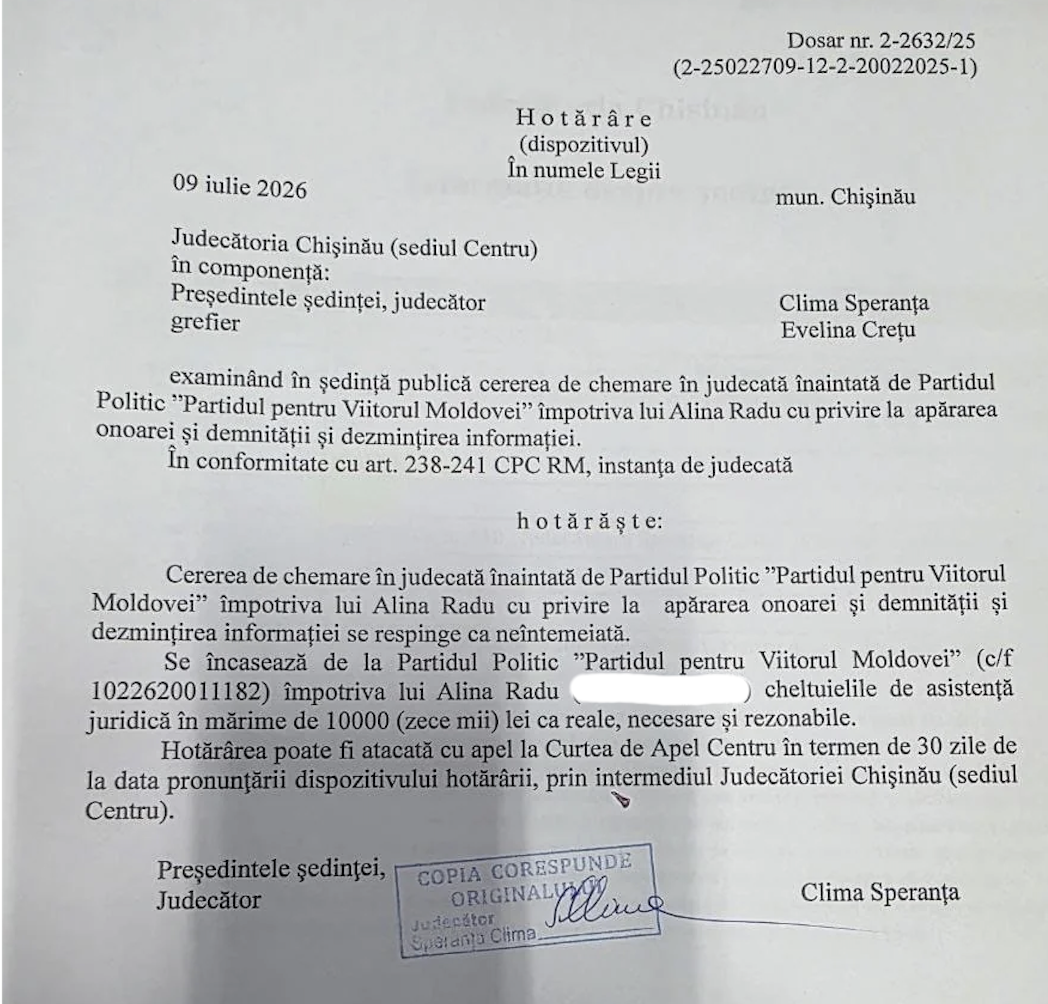
According to Ziarul de Gardă, the political party filed a lawsuit against Alina Radu in February 2025 over a Facebook post published by the journalist concerning Vasile Tarlev. The post made no reference to the party he leads.
On 9 July 2026, the Chișinău Court dismissed the claim as unfounded.
According to the operative part of the judgment, the court ordered the political party to pay the journalist 10,000 lei in legal representation costs, which it considered “actual, necessary and reasonable”.
The judgment could have been appealed to the Court of Appeal within 30 days of the pronouncement of its operative part. According to ZdG, no appeal was filed.
Nevertheless, the political party has not paid the amount ordered by the court. According to ZdG, party representatives cited financial difficulties and requested to pay the amount in instalments. This information was also confirmed to Media Azi by lawyer Vitalie Enachi, who represented Alina Radu in court. He explained that, following the failure to pay, compulsory enforcement proceedings had been initiated and the case was already at the enforcement stage.
ALINA RADU: “IT WAS A HUGE WASTE OF TIME”
Asked by Media Azi to comment on the case, the director of Ziarul de Gardă said that the proceedings had required considerable time and resources, while obtaining a favourable judgment had not brought all the legal procedures to an end.
“It was a huge waste of time and a period full of disappointments, both with certain political parties and party leaders and with the justice system, which failed to dismiss this case at the outset. We had to attend court hearings for a year and a half, and now we still have to go through judicial enforcement offices to make this politician, who has since become a member of Parliament, comply with the decision of the very court he himself turned to,” Alina Radu told Media Azi.
The journalist also highlighted the need to implement anti-SLAPP legislation and train judges to handle such cases.
“I would like the anti-SLAPP legislation to be implemented as soon as possible, and for judges to receive the necessary training to prevent such cases from proceeding to trial. I would also like voters to hold such politicians and parties accountable, rather than support them with public funds in Parliament while they harass journalists through the courts,” the ZdG director added.
LAWYER VITALIE ENACHI: “IT WAS CERTAINLY A SLAPP CASE”
Lawyer Vitalie Enachi, who represented Alina Radu in court, believes that the lawsuit filed by the party led by Vasile Tarlev had the characteristics of a SLAPP (Strategic Lawsuit Against Public Participation). In his comments to Media Azi, he referred to the way the case had been handled, including the subsequent absence of the claimant’s representatives from court hearings.
According to the lawyer, although the claimant stopped attending some hearings, the journalist and her legal representative were forced to continue the proceedings. Enachi explained that he preferred the court to examine the allegations against the journalist and rule on their merits, rather than have the proceedings terminated on procedural grounds.
Regarding the failure to pay the legal costs, Vitalie Enachi explained that, under amendments to the Enforcement Code, a person or institution ordered by a court judgment to pay a sum of money has 15 days to make the payment voluntarily after receiving a formal notice.
The journalist’s lawyer explained that Alina Radu’s representatives had sent the party the formal notice and granted the statutory deadline. The political party reportedly cited a lack of financial resources and proposed paying the 10,000 lei in instalments. As the amount was not paid, the lawyer requested the initiation of compulsory enforcement proceedings. He confirmed that the case had already been referred to a judicial enforcement officer, who is expected to take the necessary legal steps to recover the money.
Thus, although the court established the obligation to pay the legal representation costs, the actual recovery of the money requires further action by the journalist.
WHAT CHANGES DOES THE NEW ANTI-SLAPP LEGISLATION PROMISE
On 2 October 2026, Parliament adopted, in the third and final reading, the Law on Combating Abusive Court Proceedings Against Public Participation, known as the anti-SLAPP law. The new provisions are due to enter into force on 1 May 2027 and aim to protect journalists and other individuals involved in public debate from abusive legal proceedings.
Under the adopted provisions, courts will have mechanisms to dismiss manifestly unfounded claims at an early stage. Individuals targeted by such proceedings will also be able to request that claimants provide security to cover potential legal costs and damages. The legislation also provides for the possibility of imposing fines when proceedings are found to be abusive.
These measures are designed to limit the use of legal proceedings as a tool of intimidation and reduce the financial and procedural burden on those targeted. Their effectiveness in practice can be assessed once the new provisions enter into force and are implemented.
In this context, Cristina Durnea, legal adviser at the Independent Journalism Center, previously highlighted the importance of preparing legal professionals to apply the new mechanisms, in a statement to Media Azi.
“Experience shows that a well-drafted law does not, in itself, guarantee effective protection. For the law to provide the protection it is intended to offer, judges and lawyers will need to understand the purpose of these mechanisms and apply them consistently,” the legal adviser explained.