CRJM Report: Attacks on the independent media in Moldova have intensified and become more sophisticated in 2025
Mihaela Ciobanu
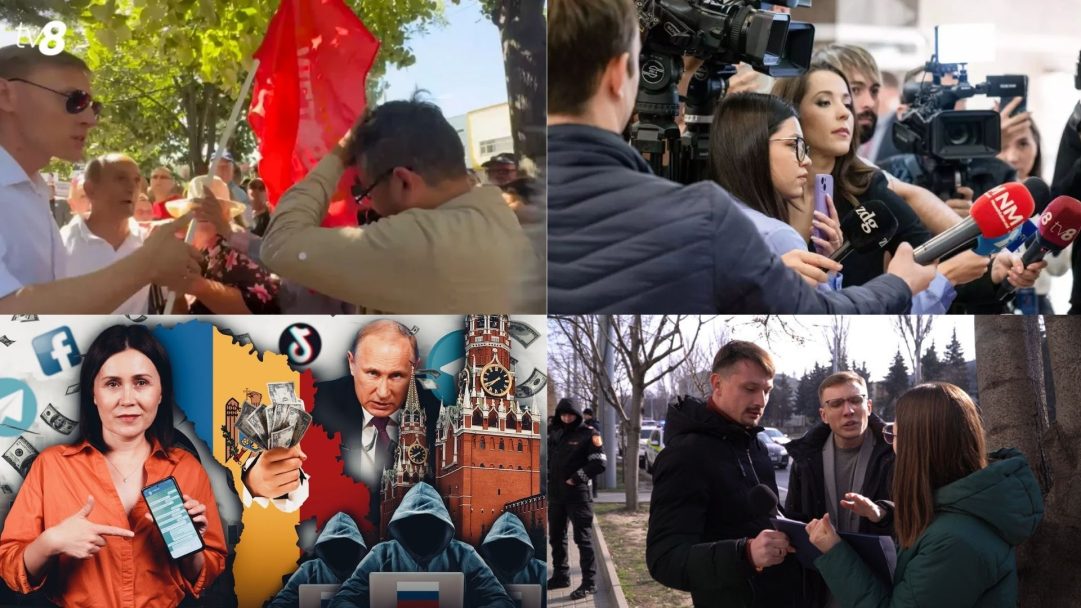
Attacks on the independent media in the Republic of Moldova remained at a level comparable to the previous year in 2025, but became more complex and aggressive, according to a report by the Moldovan Legal Resources Center (CRJM). The document explicitly notes the emergence of “more advanced forms of attack,” including the cloning of news portals on TikTok during election periods, the coordinated harassment of journalists and activists through fake accounts and defamatory comments, as well as the use of artificial intelligence to manipulate the image and identity of journalists in fraudulent contexts.
The analysis indicates that the attacks were concentrated around politically and socially sensitive moments. The authors argue that the pressure intensified in the context of the parliamentary elections on September 28, 2025, the Moldova–European Union bilateral summit on July 4, 2025, and the “Moldova Pride” festival on June 15, 2025. At the same time, the suspension of USAID activities at the beginning of the year was followed by an intensification of attacks against organizations and newsrooms that received U.S. financial support. According to the document, this episode “fueled and reinforced conspiracy theories regarding alleged ‘foreign influence,’” and independent media outlets were accused of serving foreign interests, with their activities being portrayed, “without foundation,” as “criminal.”
At the same time, the report emphasizes that the media has been systematically discredited through stigmatizing rhetoric, in which foreign funding has been turned into a tool for public attack. In this vein, labels such as “grant-eaters,” “subservient media,” “NGO oligarchs,” “cartel,” “criminal groups,” or part of a “globalist” or “Satanist” network have circulated. Experts note that such messages “aim to create a systemic perception that civil society and the press are motivated exclusively by financial gain and act on the basis of agendas dictated from abroad,” although, in reality, “external funding follows transparent procedures, subject to audit and legal regulations, and the involvement of civil society organizations in projects supported by external donors helps strengthen democracy and the rule of law.”
“At the same time, several independent media organizations, such as RISE Moldova, Ziarul de Gardă (ZdG), Nokta.md, Laf.md, AGORA, the Center for Independent Journalism (CJI), CU SENS, TV8, and Jurnal TV, have been targeted by attacks regarding their alleged political bias and association with the ‘government,’” the document states.
In addition, the report highlights a significant number of instances of direct pressure on journalists and media organizations. It mentions explicit threats, including death threats, reputational blackmail, threats of criminal prosecution, verbal or physical assaults in the field, and damage to equipment. The document insists that stigmatizing public discourse has gone beyond the bounds of legitimate criticism and has contributed to “the delegitimization of the press through extreme labeling and insinuations regarding alleged obscure financial interests,” especially when journalists have published investigations or asked uncomfortable questions. At the institutional level, restrictions on journalists’ access to courtrooms have also been reported, which, according to the report, adds pressure on the practice of the profession.
Another observation in the document is that online attacks no longer occur as isolated incidents, but as part of coordinated disinformation and harassment campaigns systematically targeting the independent press, journalists, and civic activists. The report describes the use of fake accounts, bot networks, and, in some cases, artificial intelligence to fabricate manipulative content, spread false or defamatory information, and artificially amplify certain political narratives. One example is the case of journalist Mariana Rață, who is said to have been the target of repeated online attacks, including a sponsored video in which her image and voice were reproduced using AI to promote a financial scam.
CRJM experts point out that the persistence of these practices, coupled with limited or ineffective responses from platforms and authorities, contributes to creating a climate of intimidation, eroding public trust in the media, and undermining the role of the press in a democratic society.