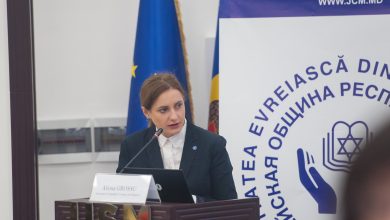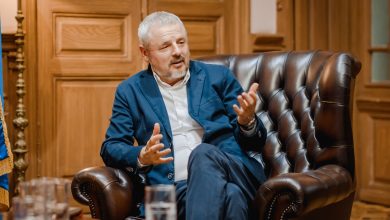
Chairwoman of the Broadcasting Council, Aneta Gonta: ‘We will be prepared to monitor non-linear media service providers during the local elections as well’
Adriana Bzovîi

Disinformation is increasingly moving online, while the Broadcasting Council tries to adapt to a constantly changing information space, amid limited human and technical resources. In an interview with Media Azi, the new Chairwoman of the Broadcasting Council, Aneta Gonta, explains how the institution is preparing to expand its online monitoring, the challenges posed by artificial intelligence, the new amendments to the Audiovisual Media Services Code, including the changes concerning Gagauziya Radio Televizione (GRT), as well as the lessons learned from the last electoral campaigns. She also discusses the new media law and the BC’s priorities for the coming period.
Media Azi: Mrs. Gonta, you have taken over the leadership of the BC in an important period for the Republic of Moldova, in the context of the need to harmonize legislation with the European one. What is the situation at the BC?
It has never been easy, especially since there has also been a constant need to report [to the European Commission, ed.]. Now we report, if not every two weeks, then on a monthly basis, on different issues. We are responsible for certain actions under the National Accession Plan or within the clusters that Moldova is going to negotiate with the European Union. It is true that we could not afford the luxury of involving the team in this process, in the sense that we do not have a separate, special department dealing with this, as other institutions do.
But the good thing is that we are up to date with everything we have had to do by September, even by December 2026. It is not easy, because the European Union asks for very concrete things. So, we have to report not philosophically, by saying what we want to do or what we have done, but very concretely, with figures and data.
Which other functions of the Council are affected by the lack of budget and human resources?
The BC has 37 employees out of the 70 positions provided for in the staffing list. Thirty-seven, including the driver, the women who do the cleaning and all the technical staff members. As for the monitoring, we have 11 people within the Directorate for the Control of Linear Audiovisual Media Services. But imagine that we have managed to cope with electoral campaigns so far, which have been extremely complicated and involved a large volume of content that we had to monitor and analyse.
Recently, we have established a new directorate, the Directorate for the Control of Non-Linear Audiovisual Media Services, which has three employees. Creation of this directorate is one of the actions we have proposed as part of the accession process. And, after the Audiovisual Media Services Code was amended last year, certain aspects relating to the AC’s powers regarding non-linear services were further detailed.
In addition, we have the problem of uncompetitive and demotivating salaries. We have no way to motivate people to join us or to stay. As for technical resources, we have monitoring software with artificial intelligence features, and this helps us considerably with transcribing texts in Romanian and Russian, because until 2023, everything was done manually. And, obviously, we would need greater institutional capacity to succeed. So, we do everything we can, but only we know at what cost.
With these minimal resources, what has the institution managed to do in such a short time to implement the amendments to the Audiovisual Media Services Code (AMSC), approved in 2025?
To have this department [Directorate for the Control of Non-Linear Audiovisual Media Services, ed.]. That is already a good thing. Even though there are only three persons, they are very good. We are now notifying providers of non-linear media services. It is a very long and difficult process. We have started in good faith, notifying everyone who might possibly be a provider of non-linear media services and telling them: ‘You can come and tell us that you produce such content, and we will include you in the register’, because we will have a separate register for non-linear services. Very few have responded, obviously. To date, we have issued 33 authorizations for the provision of non-linear media services. I think that is the latest figure. To make clear, a media service may be linear, that is, a traditional television channel, but it may also have a non-linear (online) service, and not just one. We have started by analysing linear services, traditional television and radio stations that also have non-linear extensions. Later, we have started documenting those that are only non-linear.

Do you plan to purchase specialized software for monitoring the online environment, non-linear services?
I cannot tell you whether we plan to do so. I have basically one year and a few months left [of my term, ed.]. In most cases, when there are contracts of this kind, they are for a few years at least. And it is very difficult to commit to doing certain things without knowing whether you will be able to fulfil your responsibility to the end.
We certainly do not have money to purchase special software for non-linear services. I do not think it will be possible at least next year. But my colleagues will carry out monitoring, especially if we manage to expand the team, even without special software, using the existing one. Because they have experience of manual work involving a very large volume of content. But you see that non-linear programmes are not easier —definitely not easier. We will need some rules, very clear indicators to help us remain objective and comply with the law. We have neither the intention nor the interest to interfere in editorial policy or imposing sanctions simply because we do not like someone.
In the context of the same amendments to the AMSC adopted last year, what has been achieved regarding trusted flaggers, how will this mechanism work in the Republic of Moldova and what role will the BC have in certifying them?
First of all, the concept of a trusted flagger was initially introduced in European legislation and is a new concept. All EU Member States are now certifying trusted flaggers. The notification itself will not be submitted to the AC. The Council will only maintain the register, the list of trusted flaggers. But the ‘relationship’ of the trusted flaggers will be with the platforms [Facebook, Instagram, TikTok, etc., ed.]. They will notify the platforms. The BC will not decide whether someone is spreading disinformation on a particular subject or whether they violate legislation on the protection of minors or hate speech.
So, the legal relationship, so to speak, will be with the platforms. We are intermediaries, in the sense that we certify them, that is, we verify whether they actually have sufficient experience, know what they talk about, have people responsible for fact-checking, and so on. We have already had an item concerning the registration of a potential trusted flagger on the agenda, but we could not analyse the issue, because of the lack of quorum. However, we have received such an application and we will examine it later. It will be our first experience of this kind.
Ireland certified the first trusted flagger in 2025. Do you know who was registered by the Commission? The Central Bank of Ireland, the equivalent of the National Bank of Moldova. Following several massive disinformation campaigns on issues related to finance and financial scams, the Bank has approached the Commission and has said: ‘We want to be a trusted flagger, because all kinds of things related to our activities appear online, which are not true. We want to have a direct relationship with the platforms, notify them and tell them that this is not true’. Why could the National Bank not be a trusted flagger? They probably also have human resources that could deal with this.
We want to explain as much as possible what this means [trusted flaggers, ed.] and invite institutions such as Energocom, the National Bank, or anyone who is the subject of crises. You do not necessarily have to be a media specialist or expert to be a trusted flagger. You need to have knowledge in your area of expertise, whatever that may be, and be able to provide arguments showing that this is disinformation, this is false information, etc. Youth organizations may also be trusted flaggers.
The AMSC has been recently amended again, in the first reading. According to the new proposals, TV stations could be required to broadcast 50% of their content in Romanian, while foreign audiovisual programmes could be dubbed exclusively in Romanian. What specific problem are these two measures intended to address?
The Romanian language must at least be respected, if not loved. All the proposed amendments concerning the Romanian language have come from us. We acknowledge this and we have done it with great responsibility and even with pride.
And the problem is no longer so much with providers, that is, television and radio stations, but rather with distributors. Unfortunately, what comes from abroad into the Republic of Moldova is still highly Russified. This does not mean that such content is produced in the Russian Federation. It may be produced anywhere, it may be German, French, American and other films, but still dubbed into Russian. If not Romanisation, in the best sense of the word, then at least there should be more foreign languages, such as English, German, French and others. Because the argument, especially from distributors, is always that people still choose to watch in Russian. People have this habit. Well, it is normal for people to have this habit if they have been offered this for 35 years. But we also try to convince these players on the market, to motivate them to understand that it is both their role and their responsibility to contribute to making this audiovisual space national, in the true sense of the word.
Have you assessed the risk that a reduced offer of quality content in Russian could direct the audiences towards other sources of information from the Russian Federation?
Yes, there is such a risk. On the other hand, however, since Moldovan television stations produce very good quality content in Russian than they do now, I think that some of this audience can be regained. Again, not overnight. This cannot be done in one day, and maybe not even in one year. One solution would be to provide alternatives in Russian, because the issue, as I understand, is the language. I mean, people are accustomed to consuming content in Russian. But there are also people who want specific types of content, and I see this, unfortunately, very often in public transport. There are people who watch Russian content produced in Russia. So, they need news. That is how they feel – they need to listen to Zakharova [Maria Zakharova, Director of the Information and Press Department of the Ministry of Foreign Affairs of the Russian Federation, ed.], they need to listen to what Vladimir Putin says.
I also think there may also be a desire or a need to hear an alternative to what Ukrainians say, on the subject of the war, for example. And it is okay for a person to want to hear what the other side says. From this point of view, banning it completely is not the best option. But our state protects itself as best as it can, because we have to take exceptional measures in an exceptional situation. The issue in this context is not only/so much the access to diverse information, but rather the ability of people to critically analyse what they hear/see.
The amendments to the Audiovisual Media Services Code have been criticized in Parliament, where the opposition has alleged that, under the pretext of harmonization with European legislation, mechanisms could be introduced that might limit critical voices and media pluralism. Are these concerns justified, in your opinion?
Of course not, because since we have been here, we have done absolutely nothing other than what the Audiovisual Media Services Code provides. It is true that we have started to make them work, in the sense of holding providers accountable. We have said: ‘Here is the Code, please comply with it’. I mean, how would we censor them? We have no leverage to silence voices unless we conduct a proper analysis of the content and establish that these alternative voices do not exist. Only then we can impose sanctions. But we do not shut down television stations simply because there was no second opinion, for example. The Code, however, provides for certain steps and clear mechanisms through which a licence may eventually be suspended.
Of course, these criticisms are not justified; they are used politically, probably as part of the struggle for power. We have nothing to do with either side from this point of view. We act absolutely independently and no one tells us what and how to do. A simple example is disinformation. The concept of disinformation was introduced into the AMSC in 2022, with a definition and sanctions. From 2022 to 2026, we made only one decision to impose sanctions on two audiovisual media service providers for disinformation (TV Găgăuzia and ATV, for broadcasting similar narratives).
Are you referring to the GRT and ATV case, the fines imposed in April 2024. Do you intend to extend such monitoring to other providers as well? If so, according to what criteria will the media outlets be selected?
We have received several complaints, primarily from civil society, but we also had cases initiated by ourselves. First, we have approached them lightly. We have relied on Article 13 of the AMSC, which has been called, until recently, ‘fair information’, and have proved the violations. And we kept imposing sanctions and sanctions. When they [GRT and ATV, ed.] had failed to comply and revise their editorial policies, we have realised that more serious things had been happening there. Then we have taken actions and have demonstrated that it was a case of disinformation. It has taken us four months to analyse and prove this. Sometimes we still receive complaints invoking Article 17, which concerns disinformation, but following our analysis, we find that there are no reasons to impose sanctions for disinformation.
We have a very good methodology for monitoring disinformation, and one of the key indicators is the frequency and repetition of narratives. Our methodology states that we must monitor all content for at least one week and determine whether these narratives are repeated. Only then there is a basis for starting monitoring disinformation. So, we cannot impose a sanction for disinformation based on a single statement or even two or three statements. It is not the politician who is fined, but the television station that has broadcast the content or the moderator who has failed to intervene. But some moderators may simply not know or be aware of certain things.

Since two television stations have been sanctioned for disinformation in the last four years, does this mean that disinformation has moved from television to the online space?
Absolutely. I can say that with certainty. But we also need to understand why the definition of disinformation in the Audiovisual Media Services Code is important – to serve as a tool for preventing this phenomenon. So, we definitely do not use it to settle scores with anyone or to silence those whom we may not like or whom we consider to be problematic.
AI-generated content complicates the issue of disinformation. Can the BC verify the authenticity of a suspicious audio or video recording today? Do you have tools and specialists to carry out such verifications?
No, we do not have them, in the sense that we do not have anyone specifically specialised in this area, but we intend to pay greater attention to this issue, because we have noticed that some television stations unfortunately use AI not only to generate texts , but also images, and these are not properly labelled. That is a problem. We will address the issue and regulate it, because, at present, the AMSC does not contain any provision in this regard. At the level of internal regulations, we are now revising the Regulation on Audiovisual Content. We need to make some further changes in the light of the amendments to the Code and, accordingly, we will introduce them as well. Certainly, at the level of the Regulation, this will be an important aspect.
I would like to return to the GRT issue. According to the new amendments, the regional public service provider will be regulated, for the first time, by the AC. Is there any confidence that things will change effectively? Is this the solution for ensuring accurate information at GRT?
In the recent months, things have started to change a bit, at least at the management level, that is, the people we communicate with. They are much more open and receptive to what we tell them. By the way, just today we have received the editorial policy statement on covering the elections in Gagauzia, written in Romanian. The important thing is that efforts are being made. Now, as far as management is concerned, [selecting a new GRT administration, ed.] is a challenge. We already have experience with the selection of the members of the Supervisory Board of Teleradio-Moldova (TRM), but things are a little different in Comrat. As we have organised the competition at TRM in the most transparent, fair and objective manner, we will be able to find and select very good, competent people who understand the issues and the context [in the Gagauzia UTA, ed.]. So, I am convinced that we will be able to select very good people for the Board [Regional Supervisory Board of GRT, ed.].
The People’s Assembly of the Gagauzia UTA has shared its negative opinion on the draft law concerning the Comrat-based provider. Do you see this as a risk of deadlock, a sign of resistance?
It could obviously be a deadlock at the regional level. At the same time, if the law is adopted at the national level and we begin the process, I believe that all people acting in good faith and seeking the best for this region, will comply with the law. The outcome of the elections in the region will matter a lot. If things change for the better there, then obviously there will be no resistance here either. I do not know if we are the ones who have to find solutions. It will probably have to be discussed at parliamentary level as well. We will only be responsible for organizing the competition, not for any potential deadlocks. At least now we already have good communication with the people in Comrat.
What guarantees does the new mechanism provide that the members of the GRT Supervisory Board, who would be selected through a competition organised by the AC, will be independent of both the Comrat and central authorities?
There are never any guarantees. You rely on trust and on what you see before you, in CVs and in the experience presented by the candidate. What I can guarantee is that the organization of the process and the competition itself will be conducted in the most transparent, honest and objective manner. We have no interest in any side other than the public throughout Moldova.
In recent years, you have enhanced the monitoring of television and radio stations. What is the most frequent violation, and what would be the cause?
Most of the sanctions, and the most frequent ones, have been imposed for failure to comply with the obligations regarding the broadcasting of the local product. They [media service providers, ed.] always invoke, obviously, that they do not have resources and means to invest. On the other hand, they have undertaken to produce such content. If we compare 2022, the first year in which we operated in full, with 2025–2026, I think that television stations are much more responsible. Even in their relations with us, they are much more respectful and at least attend the meetings and try to explain their position.
We have also had major problems with advertising for gambling and, probably, there will be more. Unfortunately, we understand this National Lottery differently – how it appears, where it appears and how often it should appear, including during football matches or other programmes of this kind. And we had a kind of back-and-forth, but a constructive one, with providers, in which each has substantiated its position. We had also developed a guide on this issue, which we have published.

As regards the elections, what lessons has the BC learned from the 2023, 2024 and 2025 elections?
We have learned something every time. One of the lessons is that we have taken on too much. We have succeeded, we have done things, but only we know what it cost us. We will probably have other strategies and approach things differently, because we have realised that, in certain areas, such as advertising or election campaign promotion programmes, the monitoring effort was disproportionate to the effect on the audience. By the way, we have a very good methodology, which we update every time there are elections.
Now, I admit that we will change the approach a little to be even more efficient, and our reports and conclusions will be more useful for media service providers. Although we have focused for a long time on the qualitative aspect, the public has tended to focus more on the quantitative aspect. A lot of work has been somehow lost in terms of figures. Most likely, this is what we will work on now before the electoral campaign in Gagauzia begins, in order to review this strategy a little.
What violations in the election coverage have been repeated from one election to another?
Most of them have concerned technical aspects, such as clearly separating the [electoral ed.] section, so that viewers at home know where the election coverage begins and where it ends, and then the news follows. So, the necessary separation was missing.
As for the principles of impartiality, equal distance and balance, we have imposed sanctions only at the end of the election campaign. Likewise, to see the developments from one week to the other. We have always told them, every week: ‘Look here, be careful, there is an imbalance here, and there is something else there.’ It was only at the end that we have imposed sanctions for violating this article.
What should be changed? I do not know. As regards the coverage of elections in the media, the Electoral Code has been amended to standardize the concepts. For example, the word ‘broadcast’ has been replaced with ‘programme’, so that it would correspond to the AMSC. Likewise, the number of minutes of advertising that a television and radio station may broadcast has been increased – from two minutes per day to four. This change has come after numerous requests from media service providers that have repeatedly pointed out that during the election campaign they have the opportunity to earn more money from electoral competitors. So, this is a change that has already occurred and has been published in the Official Gazette. Another change that we have very much wanted and that has been introduced into the Electoral Code is that all national media service providers declaring that they will cover the elections must be required to broadcast news, because we have had many situations in which some providers had accepted advertising, had organised some kind of debates – there would be one today and none the next day – they had made an occasional information show, but have not broadcast news. In fact, they have not informed voters about the elections or about the electoral process. By the way, this issue has been repeated in every election held until 2025 inclusive.
Do you plan to monitor online information sources during the next elections?
If there are complaints regarding certain non-linear media service providers, we are required to examine them. As for initiating a case on our own motion in connection with the elections in Gagauzia, we are not prepared, as we are in the midst of the process of granting non-linear media service provider status. We will deal with complaints only. But at the local elections [in 2027, ed.] we will already be prepared to monitor the non-linear media service providers.
Will you have the necessary technologies then?
No, we will have all the internal regulations. First of all, we will have greater clarity regarding who are non-linear providers. We will have the list, the register will already be almost complete, so we will be able to manage the process differently. I hope we will have more people, not just three, at the department [Directorate for the Control of Non-Linear Audiovisual Media Services, ed.].

At first glance, the new media law will solve the issue of transparency regarding the names of owners of media outlets. How, in fact, would this happen in practice?
The Audiovisual Media Services Code already contains provisions that oblige media service providers to disclose their owners. They are also required to notify us whenever their members and owners change. This means that we are already responsible for these aspects of transparency and, as far as audiovisual media are concerned, we will continue to be responsible for them. The mechanisms already exist.
What will change with the new law? There will probably also be this registry containing all beneficial owners of media institutions, and we will be in charge of the audiovisual aspects. It remains for us, at the AC, to develop a separate regulation and specify in details everything we are going to do, at the level of secondary regulation, just as we have done in the case of the provisions concerning non-linear providers. That law requires us to adopt these secondary regulations and to promote even greater transparency of media ownership, in particular in order to prevent media concentration.
How can we ensure that the new provisions will not be easily circumvented or reinterpreted?
They will certainly be interpreted. It depends on the Council how well and how specifically it establishes the mechanisms in the secondary legislation. Ways of circumvention will always be sought; it is absolutely obvious, and history shows us that any law can, unfortunately, be circumvented. But we will try to do as much and as well as possible, so as to avoid circumvention of these provisions.
Two years ago, another company was selected to measure audiovisual audiences. In the meantime, the Audience Measurement Association was also established. Nevertheless, the transition to this new audience measurement provider has not taken place. One of the main reasons would be the lack of financial resources. How do you see the situation?
Unfortunately, there is this deadlock; no funding has been found to change the measurement provider. Ultimately, a more practical and less expensive solution has been reached: to conduct an audit of the existing measurement system, so that we can see what is missing, what works well, what does not, and, accordingly, to invest in improving or enhancing the functionality of the existing measurement system in the coming years.
I am actually discussing this these days with a foreign expert who has experience in auditing audience measurement companies in other countries, and we are going to establish specifically when this audit will take place and during what period. Only after that we will probably be able to provide more details and recommendations concerning the existing measurement system. Few television stations are included in the measurement at present. Without being an expert in this area, I suspect that one of the experts’ recommendations will be to increase the number of television stations, whose audience is measured, because otherwise these figures do not tell us very much. They do tell us something, but they are incomplete anyway.
Are the current audience measurements credible?
From what I know and understand, as long as they are incomplete, they cannot be fully credible. This does not mean that they are necessarily manipulated or incorrectly calculated, but they do not reflect the objective reality, because not all television stations are included. There are also several other criticisms of the audience measurement provider, which is precisely why we want to initiate an audit process.
What has the Council managed to achieve in the field of media literacy, and what will it do specifically in 2027?
I was the one who, when I joined the BC in 2021 and was asked what priorities should be set or what I would like the BC to do in addition to what it was already doing, said that the regulatory authority should also provide media education. People laughed at me then, but, in the meantime, the most important thing was that we managed to include media education into the Audiovisual Media Services Code. So, as a regulatory authority, the BC also has this responsibility. I think this is the greatest achievement in this respect, because future Councils will also be required to take measures in this area.
We have various information and media education campaigns for our target audience on matters related to our activity, at the regulatory level. For example, we explain through videos and texts, especially on social media, what the BC does, what the difference between regulation and censorship is, what disinformation means, why it is not allowed on TV and why it should not exist, and what hate speech means. We have started with the most problematic issues and are continuing.
Every year we have enjoyed the support of external partners to do this, because we do not have the resources for such actions. In 2025, together with the Council of Europe, we launched a study on the level of media and information literacy in the Republic of Moldova. It is a sociological study that has revealed certain trends. We attach great importance to this project [the media literacy study carried out in cooperation with the Council of Europe, ed.] and we will conduct it again in 2027. I am not saying that it is much or that it is sufficient. Obviously, there is always room for improvement, but we also provide media education.

What are the three priorities you want to achieve over the next year and a half? Would you like to serve another term as a member of the AC?
I would like the salaries of my colleagues to be higher and to be able to complete the staff up to its full capacity. We have started very good things, and I would be sorry to see them undone in a day or a month. I hope that in another six years, the national information space will no longer be so Russified. And I have nothing against the Russian language. That is not about this; it is about us as a country and identity.
As for priorities, the first would be the elections, because they cannot be avoided. They are important to me and to the team. The upcoming elections in Gagauzia must be monitored properly, we must have very good reports, including for the next year’s local elections. That will somehow conclude our term and should be a priority. The second priority is the study on media literacy and everything related to media education. Likewise, I would like there to be greater public awareness of the AC’s activities, with what we do explained in simpler terms.
At the same time, my priority is the team. I really want to be able to invest more in my colleagues so that I can motivate them. It takes me time and effort to think about what I can do to motivate them to stay.