
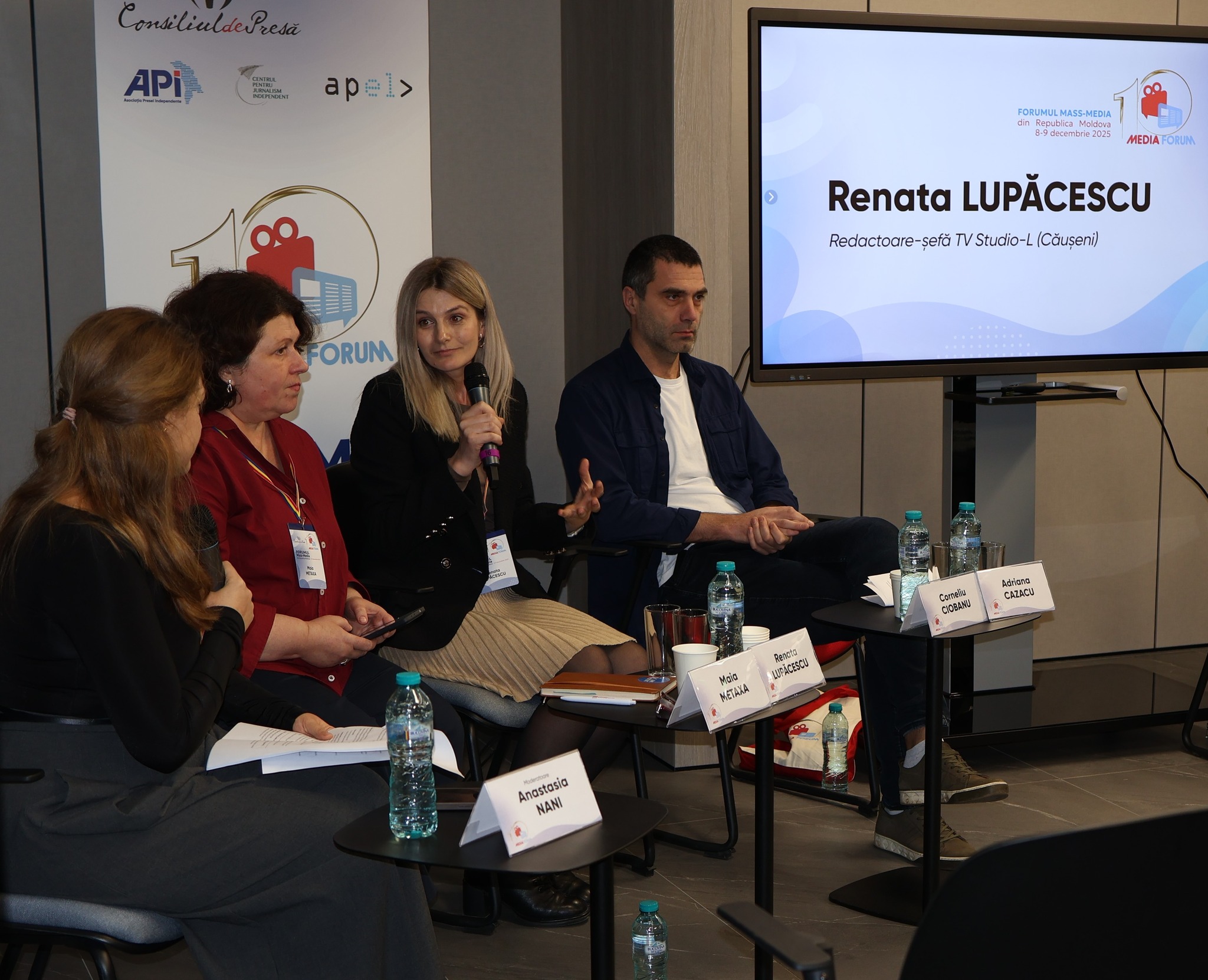
The human resources crisis remains one of the most acute problems facing media outlets in the Republic of Moldova, according to the Media Needs Study, launched by the Independent Journalism Center this summer. The reasons why specialists avoid media outlets and the point at which the gap between academic training and professional practice occurs were discussed during the debate “The media today and tomorrow: What professionals do we need, who trains them and how?” organized at the Media Forum, which was attended by editorial managers, representatives of relevant educational institutions, and authorities.
WHO IS MISSING FROM EDITORIAL OFFICES TODAY AND WHY
All the editorial managers present at the debate confirmed that the institutions they lead lack, to varying degrees, both specialized technical staff and experienced editorial staff: cameramen, image editors, editors, reporters, producers, and even editors-in-chief.
From a regional perspective, Renata Lupăcescu, editor-in-chief at Studio-L television in Căușeni, pointed out that the problem of staff shortages in local media outlets is directly linked to underfunding and demotivating salaries. “If regional editorial offices were able to pay salaries equivalent to those in the capital, then the problem of securing human resources in regional editorial offices would disappear,” she said. The journalist explained that there are qualified specialists in the region, but they choose to commute to Chișinău and work in national editorial offices because they are better paid.
Corneliu Ciobanu, deputy general director for broadcasting at the public company Teleradio-Moldova, pointed out that, despite offering more competitive salaries, the institution continues to face a staff shortage — from reporters and cameramen to producers, program makers, and editors-in-chief. “We at Radio Moldova have only one editor-in-chief for four editorial offices,” he said. At the same time, Ciobanu mentioned that there have been collaborations with local editorial offices, with salaries comparable to those in the capital, but many journalists in the regions do not have the necessary availability for such partnerships, as they are already overloaded with their own projects.
“I would say that there are professionals on the market, but they need remuneration commensurate with their skills,” noted Ana Gherciu, development director at Moldova.org. She observed that the workload, audience expectations, and low salaries are causing many talented journalists to migrate to communications, non-governmental organizations, or international institutions. As a short-term solution, the manager says that newsrooms hire students, but this requires training costs: “They come without any knowledge of how a newsroom works, and we, as employers, take on the responsibility of educating them in organizational culture.”
WHAT IS TAUGHT IN UNIVERSITIES TODAY AND HOW CAN JOURNALISM BE MADE MORE ATTRACTIVE
The same needs assessment study, as well as media managers present at the debates, noted that some young college graduates do not have adequate training for work in media outlets, nor do they have the skills adapted to the current realities of the field.
Laura Tugarev, head of the Department of Journalism Theory and Practice at the Faculty of Journalism and Communication Sciences at Moldova State University, believes that, although the situation is not “ideal,” the institution has taken important steps to modernize the educational process. “If the faculty offers — we’re not saying it’s ideal, we’re saying it’s good,” she said. Tugarev pointed out that the curricula have been redesigned and linked to the labor market, and collaboration with the Ministry of Education and Research has facilitated meetings with professionals, which have provided a clear picture of current needs.
Rodica Panța, dean of the Faculty of International Relations, Political Science, and Journalism at the Free International University of Moldova, explained that declining interest in journalism led to the merging of specialties. Although the decision was initially motivated by organizational reasons, Panța emphasized that “the merger has proven useful” in the context of geopolitical changes and the war in Ukraine, providing an opportunity to focus on the skills needed in a vulnerable information space. However, she drew attention to a major challenge: young people generally prefer “soft” topics — “they want to become influencers” — and are less attracted to security or investigative journalism. This trend, says the dean, requires additional guidance and motivation efforts on the part of the faculty.
Maia Metaxa, director of the School of Journalism in Moldova, drew attention to the attractiveness of the profession: “Journalism is not an attractive profession for many young people, which is why a change is needed in the way this profession is presented.” She proposes that journalism be presented with respect and pride, highlighting its benefits and institutions to “make young people fall in love” with this career. Metaxa also supports the use of non-formal methods and games in the teaching process, emphasizing that “the ideal state of learning is when the mind is relaxed and receptive.”
Adriana Cazacu, Secretary of State at the Ministry of Education and Research, noted the scale of public investment in journalism education, where costs per student are higher than in other fields. Despite these resources, “some graduates do not enter the labor market,” which indicates a structural problem. She points out that the ministry treats the issue as a priority, and the National Strategy for Education Development 2030 has as its primary objective the alignment of study programs with the needs of the labor market, through analysis, harmonization, and partnerships with the media sector.