
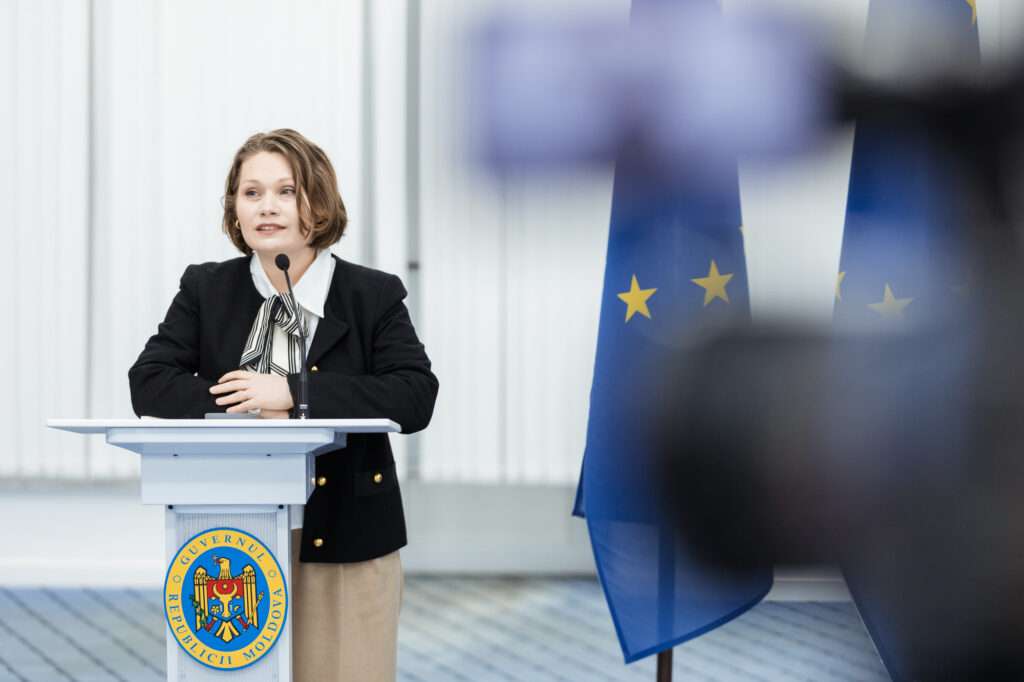
Digitalization brings, on the one hand, important opportunities for development and innovation, but, on the other hand, increasingly complex risks — from disinformation and online fraud, to a growing exposure of users in the digital space. In this context, regulation becomes essential, and for the Republic of Moldova, as a candidate state for accession to the European Union, this process must be accelerated in order to align with community standards. Media Azi discussed priorities in the field of digitalization, the transposition of EU legislation, the fine line between regulation and censorship, cooperation with major platforms, as well as the level of digital literacy and the impact of social networks on the younger generation with Michelle Iliev, State Secretary for Digitalization at the Ministry of Economic Development and Digitalization.
Media Azi: Mrs. Iliev, given that the transposition of several EU directives and acts into the national legislation is a priority in the coming period for our country, which of these, under the responsibility of the Ministry of Economic Development and Digitalization, take precedence and what effects will they have on the economy and citizens?
Michelle Iliev: For us, digitalization is not just a technical reform. It is the way we are changing how the economy and the state work. Our objective is very clear: by 2030, we want a digital-by-default state, where interaction with institutions is simple, fast, and largely online. In other words, the digital option should become the most natural and convenient choice for both citizens and businesses.
The Ministry of Economic Development and Digitalization directly manages nine out of the 35 negotiation chapters with the European Union. The areas we coordinate are among the most important for the functioning of the economy: the domestic market, freedom to provide services, competition, the information society, and industrial policy. In practical terms, we have several very clear priorities.
First, we are working on the national framework for artificial intelligence and on the transposition of the AI Act (Artificial Intelligence Act), because we want to create a space for innovation while also establishing clear rules for the responsible use of these technologies. AI is rapidly becoming an essential economic infrastructure, and we must be prepared both legislatively and institutionally. We are also advancing with the digital wallet, which will change the way citizens identify themselves, sign documents, and access public or private services. It is a key tool for interoperability with the European space and for developing a modern digital economy. Last year we built the legislative and institutional foundation in the field of cyber security. This year, we are moving forward with the final alignment to the NIS2 Directive, in order to strengthen the resilience of critical infrastructure and the state’s ability to respond more effectively to cyber risks. Another important file is the implementation of the Law on the freedom of establishment of service providers, which simplifies companies’ access to the market and reduces administrative barriers. We are also preparing for the implementation of the Gigabit Regulation, which will accelerate the development of connectivity infrastructure and ensure the necessary conditions for a competitive digital economy.
All these reforms pursue the same objective: a more competitive economy and a more efficient state.

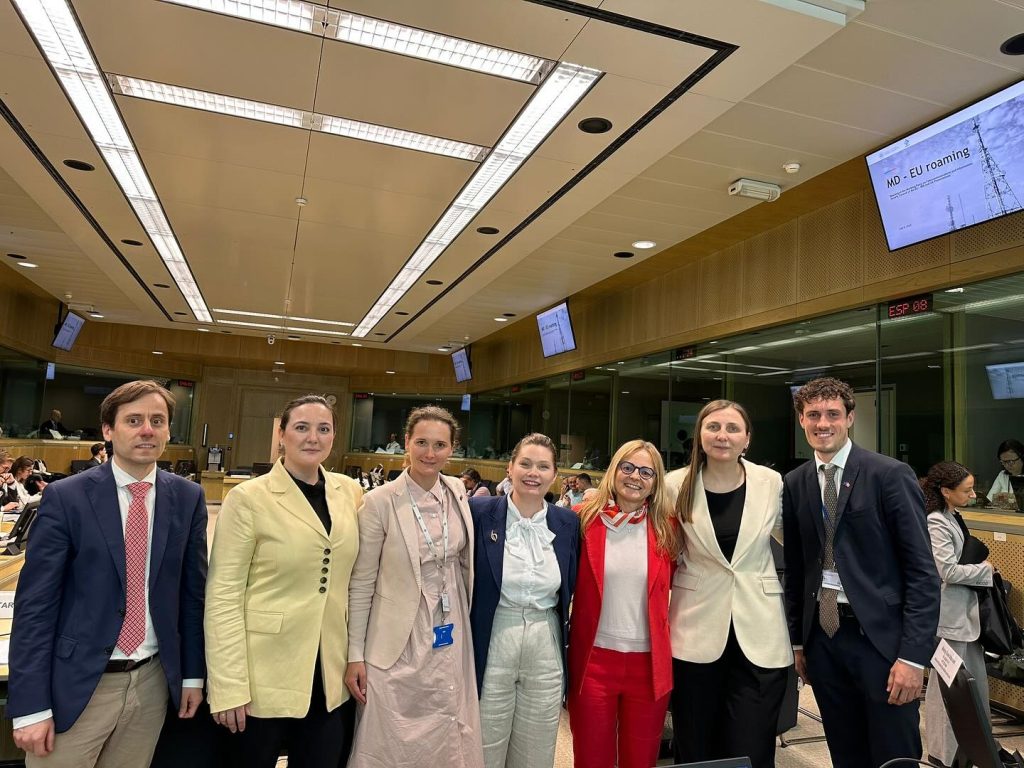
Another European act relevant to the information space is the DSA (Digital Services Act), which you also spoke about at the Mass-Media Forum in December 2025. What does the transposition of the DSA mean specifically for the Republic of Moldova?
We are currently at the final draft stage of the project. At this point, the solution we will use is to regulate national platforms. The responsible authority will most likely be the National Regulatory Agency for Communications (ARCOM), as it is already a focal point for both local and large platforms. And the interaction with large platforms, such as Meta, Google, Facebook, will remain under the competence of the European Commission. There will be a so-called gap until accession. We will continue using the mechanism established last year, based on notification and a point of contact through ARCOM. Therefore, we will not have a direct regulation of these platforms, because, since these companies are not under the jurisdiction of the Republic of Moldova, it would be very difficult to make them to comply with the rules.
In practical terms, the changes that should be felt once this act is applied will primarily concern the verification of local companies that have a digital and information component. Moreover, we will have a transition and adaptation period, especially since we plan to adopt the legal framework in the autumn, around September. This means that information campaigns will also be carried out in parallel. Practically, systems will become functional and we will be able to obtain data or a clearer understanding of the situation. As for the large platforms, we will continue using the same mechanism: if a disinformation campaign, fake news or any other deviations from the DSA framework are identified, the Agency will report them to the European Commission, which will then alert the large companies, after which we will receive feedback.

In recent election campaigns, representatives of the Central Electoral Commission and other authorities often stated that the Republic of Moldova is a too small actor in the dialogue with large digital platforms. How do you see this cooperation?
The platforms were generally quite open, with the exception of Telegram. From what they explained to us, they operate on the basis of algorithms, and at the European level there is practically only one person who validates if something abnormal is happening. It is clear that a single person for the entire European information space cannot easily identify how a country like the Republic of Moldova is being targeted. That is why our intervention is necessary — to be much more proactive and to raise alerts when we observe situations that the algorithms fail to detect. Those who create such content know very well how to bypass automated detection systems.
In practical terms, protecting citizens involves, in addition to information and awareness campaigns, the development of media literacy, including a basic form of ‘AI literacy’ — literacy in the field of artificial intelligence — because we need to understand how content generation works, including video. Many people believe what they see, and the generated content is becoming increasingly easy to produce.
Another solution proposed by the European Commission is the integration of the digital wallet into these platforms. This would give each user a unique identifier — not a personal ID, but an ID generated on the platform — that would confirm that the user is real. This measure would help combat fake account networks and ‘bot farms’ that artificially amplify content and its distribution. It would also protect personal data, as authentication would only confirm that the user is a real person, without exposing sensitive information. Fake accounts are one of the main factors contributing to the spread of false materials and the artificial increase in the popularity of certain content.
‘DIGITAL SERVICES ACT DOES NOT TELL PEOPLE WHAT THEY CAN OR CANNOT SAY ON THE INTERNET’
The opposition, as well as some online voices, says that regulating social networks would mean censorship. What would you respond to them?
Regulation does not mean censorship. It means basic rules in a space that became essential to society.
The Digital Services Act does not tell people what they are allowed and not allowed to say on the Internet. Instead, it requires large platforms to take responsibility for illegal content and for the systemic risks they create. This includes things such as coordinated disinformation networks, fake accounts, or content that endangers children. A simple way to explain it is this: we have traffic rules not to prohibit driving a vehicle, but to prevent accidents. The same applies in the digital space — rules exist to protect users and to create a predictable environment.
How do you think these differences should be communicated to the public?
Communication needs to be much clearer and closer to people’s reality. Sometimes the state explains public policies in overly technical terms, but citizens do not live in legislative concepts, they want to know what changes specifically for them. That is why we try to use more accessible formats: video explanations, info graphics, interviews or public campaigns. The core message must be simple: protecting personal data or combating online fraud does not limit people’s freedom. On the contrary, it protects their rights and creates higher safety in the digital space.
Many international reports, as well as our own authorities, point out that foreign interference poses a risk to state security. Will such foreign interference also fall under the scope of the DSA in one way or another?
Yes. Combating online manipulation and interference is one of the key objectives of the DSA. Very large platforms are required to assess and reduce systemic risks, including coordinated disinformation campaigns or manipulation of electoral processes. For the Republic of Moldova, this is extremely important. In recent years, we have seen how easily social networks can be used for destabilization or manipulation. By aligning with European legislation, we become part of a much stronger framework of cooperation and protection.
Where do we draw the line between combating illegal content and protecting freedom of expression?
The line is drawn by European standards on fundamental rights. Illegal content, such as incitement to violence or child abuse, must be removed quickly. In the case of disinformation, the approach is not to eliminate opinions, but to limit artificial manipulation. This means greater transparency regarding algorithms and how content is amplified. Platforms must apply their own rules transparently, and users must be able to challenge their decisions.
At this stage, how significant are the limits of regulation?
Obviously, we need to maintain a balance. If regulation becomes too rigid, we risk blocking innovation. If there are no rules, major risks arise for society. The European model tries to do exactly this: clear rules, but also space for technological development and experimentation. We also want Moldova to be competitive and attractive for those who want to experiment here. Therefore, in some areas, approaches will be conducive to deregulation and providing much-needed space for innovation.
‘WE URGENTLY NEED A “DIGITAL SHIELD” THAT EXTENDS TO SOCIAL NETWORKS’
How do you assess the role of social networks in public life? At this moment, do they bring more benefits or more risks?
Social networks profoundly changed society. They democratized access to information and became important tools for entrepreneurs, creators and companies. The generation of the 1990s, including myself, was the last to grow up without the Internet and the first to experience its first wave. Our adolescence coincided with the emergence of the first social networks and online messaging applications. Today, online safety can no longer be treated in a fragmented way. We urgently need a ‘digital shield’ that extends to social networks. Because the way algorithms work can enhance polarization or disinformation. We are at a time when we need to rethink this status quo, through digital education, clearer rules for platforms and levers for users.
At the press conference dedicated to the launch of the national campaign ‘Let’s use artificial intelligence safely’, organized on the occasion of the Safer Internet Day, you said that the current generation of children and young people is made up of ‘digital natives’, and also remains ‘digitally naive’. What impact do you think social networks have on the culture and education of the younger generation?
The fact that a child knows how to use a smart phone does not mean that he understands the risks in the online environment. Social networks influence the way young people perceive reality, relationships and even self-image. We already see serious problems: cyber bullying, digital addiction, manipulation or online exploitation. That is why the answer cannot be technological alone. We also need digital education and development of critical thinking.


I am a mother of two children aged three and five and, like any parent, I worry about the digital world they will soon enter, whether I want it or not. There, they will also be exposed to widespread disinformation. Some data from a recently published study show that children trust 80% of the answers provided by chat bots and the content on social networks. Our role, as parents and as a state, is to ensure that the online environment for them is safe – while trying to protect ourselves from fraud and concerted attacks. It is like a cat-and-mouse game.
There is already open discussion about limiting children’s access to social networks. Australia, the Netherlands, France announced restrictions of access starting this autumn. We are also preparing from a technical point of view. The e-Government Agency is developing a digital wallet, initially designed for public services, but also as a secure solution for age verification on social platforms, without exposing personal data. The goal is not control, but the protection of children in the online environment.
‘THE DIRECTION IS CLEAR, BUT THE SPEED DEPENDS ON HOW WELL WE WORK TOGETHER’
Do we have a sufficiently well-prepared population today in terms of digital skills?
Not yet. We have a very competitive IT sector and young people who deliver quality products and services globally. But if we look at society as a whole, there are still significant gaps, especially between urban and rural areas. Digital competence, however, does not just mean using an app. It means knowing how to protect your data, recognize online fraud or use technology to be more productive. That is why we invest heavily in digital education and support programs for companies and citizens, and are thinking of new programs to ensure that the population is prepared.
In this regard, what should the state do and what is the responsibility of society?
The state must build the infrastructure: connectivity, digital services and a legal framework that encourages innovation. At the same time, we offer concrete tools: grants for SME digitalization, digital innovation hubs, AI integration programs and start-up funds. But digitalization is not only the responsibility of the state. Companies must invest in new technologies. Universities must train specialists adapted to the digital economy. And every citizen must become an informed user of technology.

In two to three years, what would a healthier online information space in the Republic of Moldova look like, from your perspective? What would be two to three concrete indicators by which we could measure this evolution — either in data, in the practices of institutions, or in the behaviour of platforms?
In a two to three year period, a healthier information space would mean, first of all, a change in the way platforms operate. Users reached a certain level of maturity and understand the risks better. If 10–15 years ago social platforms were seen as community spaces, today they became mostly business and monetization tools. In the future, they will further integrate digital tools, including the digital wallet.
In this context, three elements are essential: removal of inauthentic and false content, clear labelling of AI-generated content, and control of minors’ access to platforms. Protecting minors is crucial for a safer and cleaner information space.
Is approaching the EU a guarantee that things will automatically evolve in the right direction?
The EU provides the framework, the rules and the resources. But the final outcome depends on us. Digital transformation is not carried out only through laws or government programs. It is carried out through collaboration between the state, the private sector, academia and society.
The direction is clear. But the speed depends on how well we work together.