Promo-LEX Report // Freedom of expression marked by discrepancies between legal provisions and practical reality
Mihaela Ciobanu
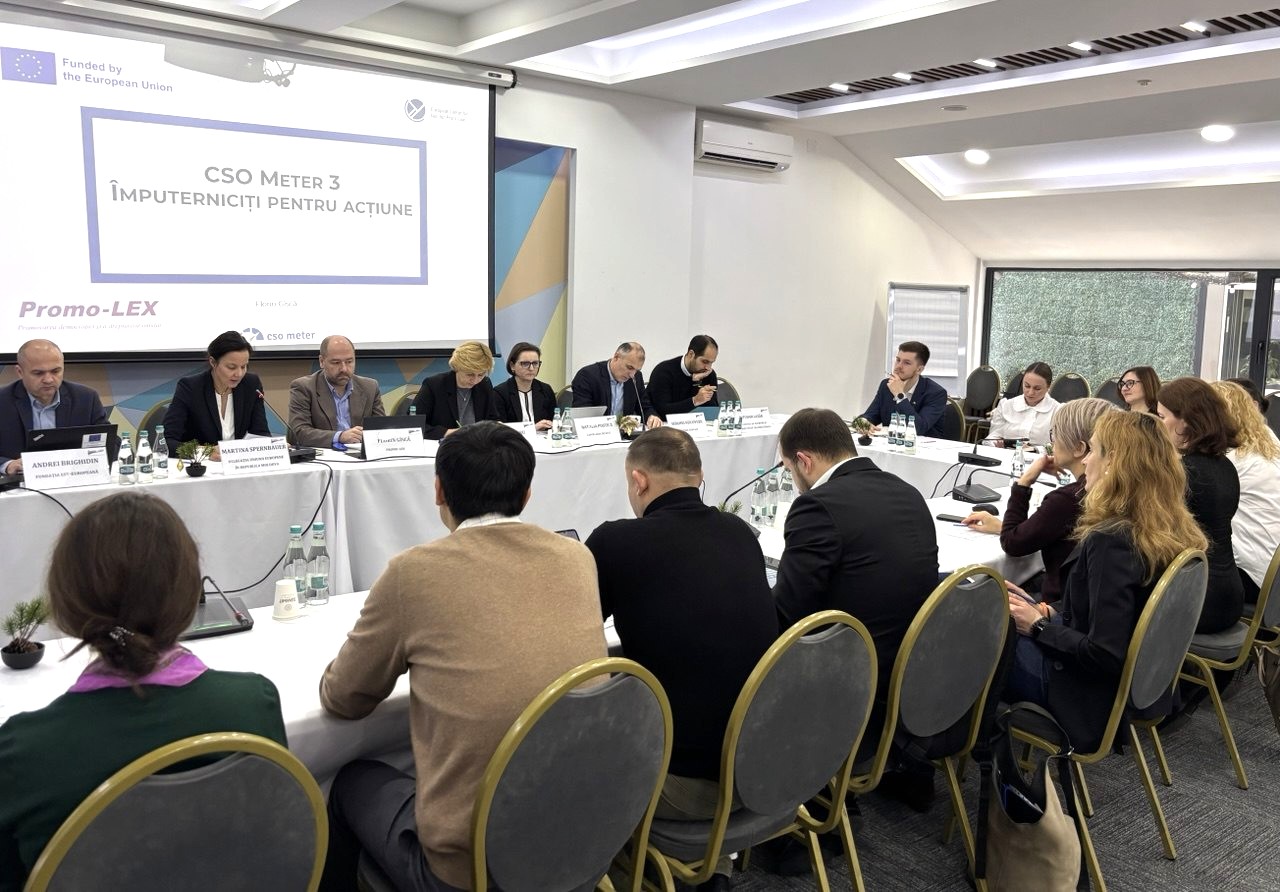
In the Republic of Moldova, there is a discrepancy between the legislative framework and practical reality in the media field. From a legal point of view, there are no barriers limiting the free use of mass media, and the legislation explicitly states that no one can prohibit or prevent the media from disseminating information of public interest, in accordance with the law. However, in practice, phenomena such as misinformation, lack of institutional transparency, and insufficient effective legal mechanisms to protect journalists persist. These findings are highlighted in the report CSO Meter Moldova 2025, launched by the Promo-LEX Association in December.
According to the report, concerns remain about the mechanism introduced at the end of 2023, which allows for the extrajudicial suspension of broadcasting licenses. This mechanism has been criticized by civil society organizations for its lack of transparency and non-compliance with international standards in the field of freedom of expression and freedom of the press. In addition, research indicates that most media outlets are controlled by business and political groups, many of which are heavily influenced by fugitive oligarch Ilan Shor. As a result of the suspension of broadcasting licenses, a significant portion of media content has migrated online, where regulatory and accountability mechanisms are more limited.
The document indicates that journalists continued to be victims of multiple forms of aggression, including cyberattacks such as hacking of personal accounts and YouTube channels, death threats, physical assaults, acts of intimidation, verbal threats, and denial of access to court hearings. The public television station was also again the target of acts of vandalism. “Politicians frequently file defamation suits against critical media, which wastes time and resources for media organizations,” the report also notes.
Experts draw attention to the increase in SLAPP (Strategic Lawsuit Against Public Participation) cases, i.e., strategic legal actions brought to intimidate, discourage, or silence journalists, civic activists, or media institutions through legal and financial pressure, rather than to obtain legitimate redress. According to the authors of the report, “up to 70% of media cases examined by the Supreme Court of Justice between 2019 and 2023 were SLAPP cases, mainly targeting media sources, and more than half of these were initiated by politicians or state officials.” However, the Ministry of Justice has initiated a draft legislative amendment aimed at countering SLAPP and strengthening the legal protection of freedom of expression.
In addition, experts point out that, in the summer of this year, Parliament amended the Audiovisual Media Services Code with the aim of strengthening the independence of the public institutions Teleradio-Moldova and the Audiovisual Council, as well as introducing a regulatory framework for video distribution platforms. The new provisions require platforms to adopt measures to protect minors and the general public from harmful content, and the Audiovisual Council is empowered to restrict the retransmission of foreign media services under certain conditions provided by law.
The report also indicates that non-commercial media continued to receive public subsidies totaling approximately 35 million lei. However, the subsidy mechanism has been criticized in the public sphere, with reports of cases where funds were directed to media outlets with political affiliations or that do not comply with the provisions of the Journalist Code of Ethics.
The authors of the study also put forward a set of recommendations. These include the establishment by the government and the competent authorities of a clear, predictable, and transparent mechanism to combat disinformation, including procedural guarantees and the right of appeal. It is also recommended that the Audiovisual Council’s capacity to monitor online content be strengthened and that legislation on video-sharing platforms be harmonized with the EU acquis, in particular with the provisions of the Digital Services Act and the European Act on Press Freedom. At the same time, the authors stress the need to adopt anti-SLAPP legislation, in line with European standards, to protect the media from abusive legal actions.