Press cartoons, increasingly under pressure: 87 cases of threats have been documented worldwide over the past two years
Mihaela Ciobanu
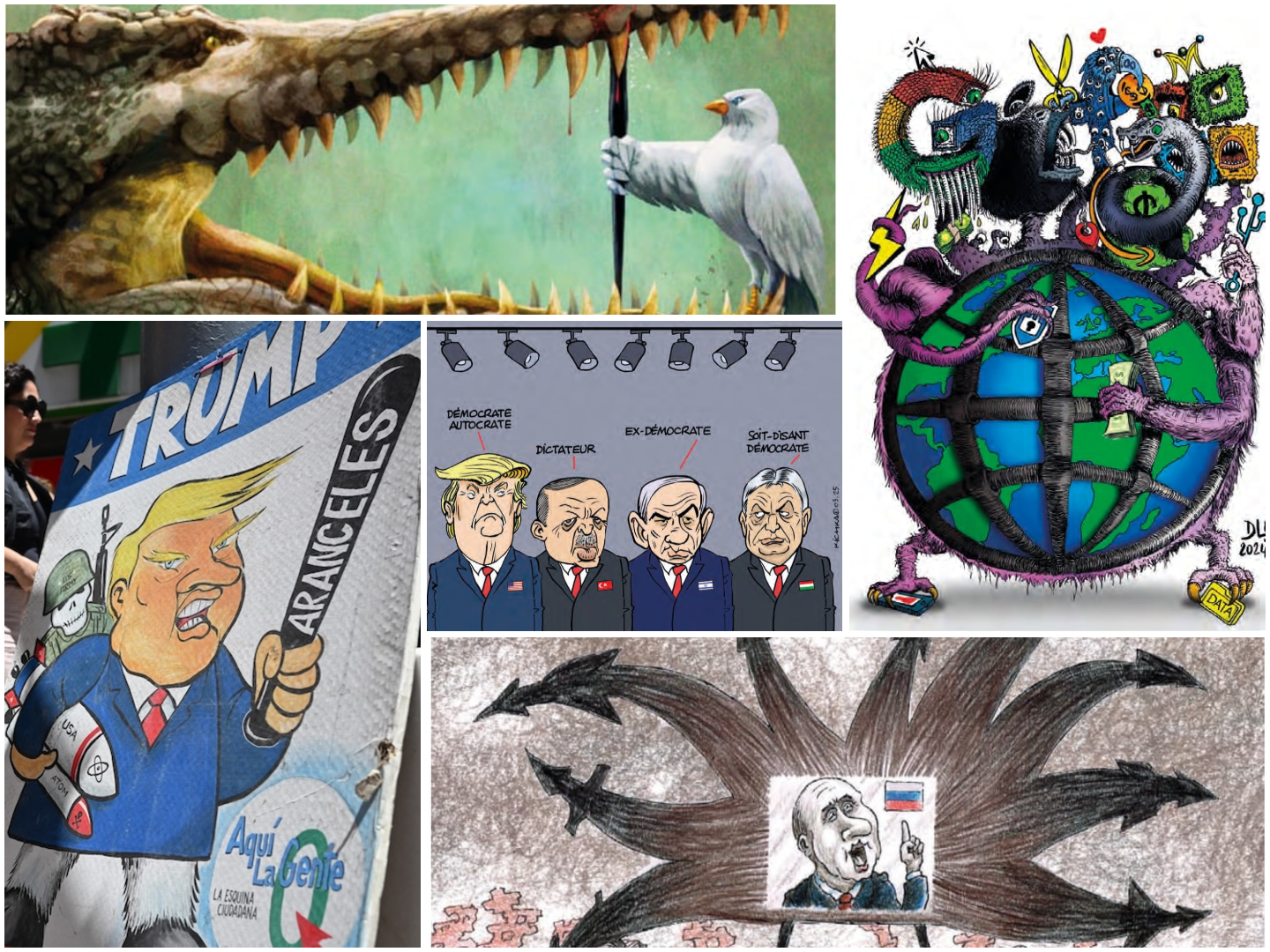
87 cases of threats against press cartoonists worldwide were documented between 2023 and 2025, according to the latest report on abuse, censorship, content restrictions, and other online challenges faced by cartoonists, published on March 22 by Cartooning for Peace—an international network of press cartoonists. The report shows that pressure on the profession no longer comes solely in the form of direct violence, but increasingly through lawsuits and censorship—mechanisms that fuel fear and self-censorship. In the authors’ assessment, repression thus becomes more “insidious,” as it is carried out through legal and editorial means.
In their two-year review, the authors note 22 cases of legal proceedings brought against cartoonists and 14 cases of censorship, in addition to other forms of pressure. The report emphasizes that this trend indicates the development of repressive mechanisms that attract less international attention than physical violence but produce the same effect: the restriction of freedom of expression.
EUROPE: NO PHYSICAL ATTACKS, BUT LAWSUITS AND LEGAL INTIMIDATION
The data shows that, although in many European countries cartoonists continue to publish under the protection of the rule of law, the continent “is not immune to global trends.” The report cites the Council of Europe’s observations regarding disproportionate restrictions on freedom of expression and notes that, during the period analyzed, no cases of physical violence against cartoonists were recorded, but they faced private lawsuits, criminal prosecutions, and SLAPP suits (Strategic Lawsuits Against Public Participation), intended to intimidate and silence critics by dragging them into court.
U.S.: CENSORSHIP, POLITICAL PRESSURE, AND EDITORIAL SELF-CENSORSHIP
The United States emerges in the report as a new hotbed of pressure on cartoonists, a reversal that the authors describe as unimaginable until recently: “Even in this giant democracy, this empire of editorial cartoons, which for many years had the largest number of cartoonists in the world, the sector is in rapid decline.” The analysis indicates that pressure on cartoonists comes not only from the authorities but also from an increasingly tense political and media climate. The authors highlight three main mechanisms: direct political pressure, public smear campaigns, and self-censorship in newsrooms—that is, situations in which editors or media outlets avoid publishing sensitive cartoons for fear of scandal or political backlash.
The report cites the case of cartoonist Ann Telnaes, who resigned after The Washington Post rejected a cartoon of Jeff Bezos and Donald Trump. The authors describe the episode as an emblematic case of self-censorship in the American media.
THE MIDDLE EAST: WAR, IMPRISONMENT, AND EXTREME PUNISHMENTS
With regard to the Middle East, the report describes the region as a place where caricature faces “absurd violence.” One of the central cases is that of Saudi cartoonist Mohammed Al Ghamdi, known as Mohammed Al Hazza, who was arrested in 2018 after publishing cartoons in the Qatari newspaper Lusail. According to the report, toward the end of his initial six-year sentence, a secret trial took place that extended his sentence to a total of 23 years, with no possibility of appeal.
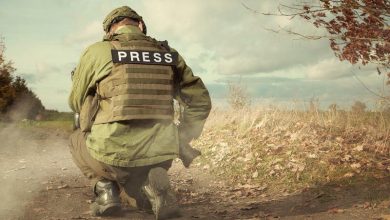
At the same time, the analysis focuses on the situation in Gaza. The document notes that, over the past two years, nearly 220 journalists have been killed in the enclave, at least 67 of them while on the job, according to data from Reporters Without Borders cited in the report. In October 2024, Palestinian cartoonist Mahasen al-Khateeb was killed in an Israeli military airstrike, and cartoonist Safaa Odah is described as being starved, forcibly displaced, and trapped in Gaza, while she continues to draw about the fear and vulnerability of children under bombardment.
WHAT THE AUTHORS RECOMMEND
The authors of the report make a series of recommendations directed specifically at digital platforms and media organizations. They call for clearer and more effective mechanisms for reporting online insults, threats, and censorship, including independent channels for situations where censorship is carried out by state actors. The report also recommends that platforms’ moderation policies comply with international standards on human rights and press freedom, that female cartoonists be better protected against technology-facilitated gender-based violence, and that platforms explicitly include the situation of cartoonists in their assessment of systemic risks generated by their own policies and algorithms.
At the same time, the document calls on media institutions to publicly support cartoonists in the face of attacks and controversies, and regarding artificial intelligence, it calls for content traceability, transparency regarding the datasets used to train models, and compensation for authors for the unauthorized use of their work.