
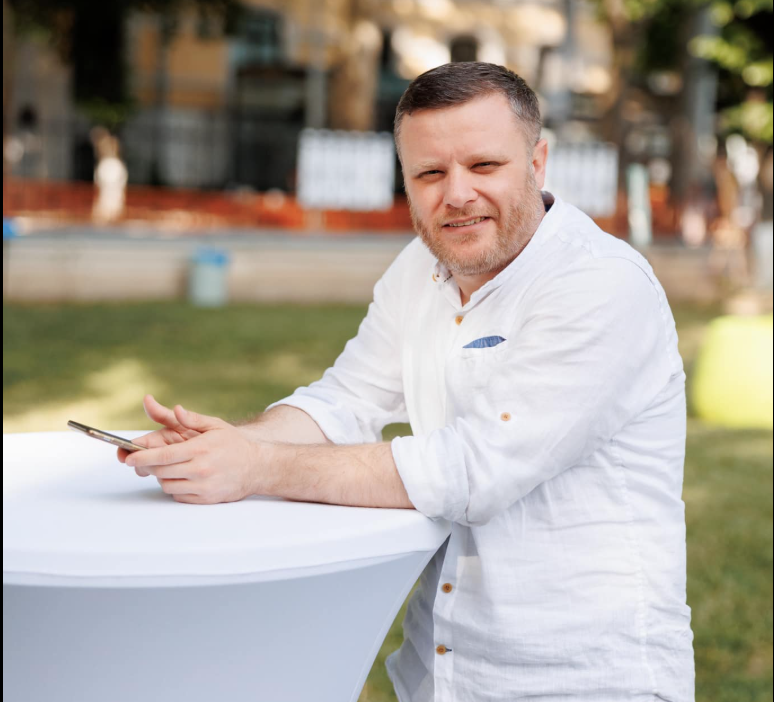
Victor Gotisan, media researcher
For the past few days, in the Republic of Moldova we’ve been witnessing an interesting and revealing situation that shows how the relationship between the media, politicians, and public opinion actually works. After the parliamentary elections in September, a new PAS majority emerged in Parliament, allowing the party to assume responsibility for forming the government. Two weeks later, the name of the candidate for the position of prime minister was announced: Alexandru Munteanu. Nothing unusual so far. However, the surprise came immediately afterwards – almost no one knew who Alexandru Munteanu was. Neither the press, nor the experts, nor the public. An unknown name, with no public track record, no visible political involvement, no presence in civic discourse.
From silence to a media storm
The reaction of the Moldovan press upon hearing the name of the future prime minister was one of curiosity mixed with suspicion, which is justified. Journalists wondered who the man who was to become the third most powerful figure in the country; what he had done so far; what his professional experience was; what values guided him; in what fields he worked and what relationships he had established up to this point. Therefore, they began to look for answers. They consulted databases, spoke with various sources, analyzed the professional profile, and compared information, data and figures. This is exactly how things should happen in a healthy democracy and how proper research on a topic of public interest is normally conducted. However, instead of being seen as a legitimate exercise in transparency, this investigation was interpreted by many – politicians, opinion leaders and representatives of the civic sector – as a way to put pressure on the candidate for the position of Prime Minister in Chisinau. It was suggested that the press rushed in with information too early, that it was not giving him the chance to prove himself, and that it was unfair to dig into his past, etc. In essence, nothing more was done than to convey a dangerous message: the press should remain silent until the candidate becomes officially Prime Minister. In other words, it should self-censor (NB: more on self-censorship and its implications below).
In this context, the ‘Munteanu case’ has reopened a series of discussions about the press and how it functions – old topics, but still highly relevant. Let’s take them one by one.
Where and when private life ends and public responsibility begins
The moment someone accepts a public office, their private life ceases to be entirely private. Not because the press would have any pleasure in invading people’s privacy, but because public office requires trust, and trust is built on knowing all relevant details about a person nominated or elected to a position.
You cannot ask society to follow you in your mission as head of a Government simply because you were proposed by a certain politician or party, no matter which one. Public office comes with exposure, transparency, and the obligation to provide explanations for everything and everyone, including what you are and whom you represent. Therefore, the boundary between private and public life is not drawn by the press, but by the public office itself. The moment you accept to lead a government, you also accept the fact that the past, present, connections, family, relationships, business dealings, and previous positions become part of the public interest.
Who sets the media agenda
The simple and direct answer: no one, only the press itself. The ‘Munteanu case’ highlighted a phenomenon that we seemed to have escaped: the temptation of politicians to control or influence the media agenda. Instead of encouraging quality journalism, some prefer to give lessons about what ‘is good for the press to write’ or what is ‘correct’ or ‘ethical’ for the media to publish. In this case, a kind of subtle pressure was created on the editorial offices, suggesting: ‘Don’t write too much, don’t disturb too much, don’t spoil the moment’.
What we need to start understanding (all of us!) is that, in a democracy, the press does NOT need the politicians’ approval to cover a particular topic, especially when it is of public interest. The press must fulfil its basic functions: informing, explaining, educating, entertaining, etc. In addition to these, the press has another (perhaps the most important) mission — the right to ask uncomfortable questions, to investigate and verify who those aspiring to key state positions really are. The attempt to blame journalists simply for doing their job is not only a misunderstanding of the role of the press, but a form of intimidation. A subtle way of saying: ‘You have freedom of expression, but only within the limits that suit us.’
And yes, asking the press to be silent ‘until the right moment’ is equivalent to asking it not to perform its function. It’s like asking a doctor not to diagnose a patient until it’s too late for treatment.
How ‘harsh’ should the press be or when the watchdog must bite
The press is often described as the ‘fourth power in the state’ or the ‘watchdog of democracy’. But a watchdog that only barks, without biting when necessary, becomes merely decorative. The role of the press is not to please those in power, but to monitor them. The press should not seek applause, but truth. Therefore, journalists have not only the right, but also the obligation to ask themselves about anyone who is going to hold a public office.
If the media doesn’t do it, who will? State institutions? The experience in the recent years shows that we cannot always rely on the authorities to filter the integrity of decision-makers. Whether we like it or not, most of the time, journalistic curiosity remains the only and most effective filter of the integrity of public figures. Investigation of someone’s past and present, their connections and possible conflicts of interest by the press should not be seen as a witch hunt, but rather as a ‘media pre-vetting’ – a guarantee that society knows who it entrusts with decision-making on its behalf.
Freedom of the press and the three fundamental principles
To reiterate: the press is free to write about anything, anyone, at any time. It does not need to ask anyone’s permission to address a specific subject. However, in exercising this freedom, there are also some major principles that the media must follow and take into account.
- First, public interest. The press must deal with issues that concern society as a whole. Appointment of a prime minister is undoubtedly a subject of major public interest.
- Second, good faith. Of course, the right to write about someone does not mean the right to defame. The press must act with the clear intention of informing correctly, not of causing scandals for free. In simple terms: good faith validates the first principle – public interest. Did the press act in good faith regarding the ‘Munteanu case’? To a large extent, yes.
- Thirdly, responsibility. Freedom of expression does not exempt anyone – including the media – from accountability for what you have declared, published or broadcast. Journalists cannot invoke the right to free expression to spread unverified or manipulative information.
These principles are not theoretical. They define, in practice, the credibility of the media. If they disappear, we can no longer talk about an independent press.
The ‘Munteanu case’ – between the right to reply and haste or where the press (nevertheless) ‘went wrong’
Journalism and the way the media operate have changed significantly in the last decade. Social networks have completely reshaped how information is consumed. The formula ‘who is first’ has replaced accuracy and quality. The temptation to publish quickly – without waiting for the right to reply or the opinion of the person concerned – is huge. However, we must not forget that quality journalism is not measured by speed, but by accuracy, and the right to reply remains a cornerstone of professional ethics.
Referring to this case, what bothered me is the fact that I can understand the disclaimer ‘X or Y did not provide a response by the time this news bulletin was broadcast’ or ‘X or Y did not answer our calls to comment on the information’ in the context of a news report, but I cannot understand the situation in which the person targeted in an article with investigative elements or in a journalistic investigation is given only a few hours – or even minutes – to answer a set of questions. What I want to emphasize is that, if you seek the opinion of someone targeted in such a material, to the detriment of the temptation to be the first to publish the information, it is essential to give them a reasonable time to respond. And in this case, some media outlets have made a mistake. Failing to offer this opportunity is not just a professional mistake, but a gesture that on the one hand undermines the credibility of the profession, and on the other hand provides ammunition to those who are eager to accuse the press of acting in bad faith.
Self-censorship – the silent disease of democracy…
In recent years, a discreet form of self-censorship has taken hold in the press. After 2021, when a pro-European and reform-oriented government came to power, many journalists have become more reserved in criticizing it. If in the years of previous governments the press was more active and incisive, today one can observe a caution born out of a reflex of ‘not harming a good cause’. Prolonged over time, this restraint – arising from apparently noble intentions – risks, in the long term, becoming a dangerous habit. I do not believe that this phenomenon was intentional. Most likely, most editorial offices were not even aware of this slight slippage. Self-censorship, as a rule, does not emerge through a deliberate decision, but rather quietly, as an adaptation to the context – including the regional one. This is how we end up avoiding certain topics or political actors simply because, as Viorel Mardare said, ‘the times were or are like that’.
However, it is important for the press to understand that, in the long run, any form of self-censorship – even an involuntary one – becomes dangerous. It is a process that, step by step, can open the door to censorship imposed by those in power. The ‘Munteanu case’ showed how easily this reflex of caution can be turned into a tool for intimidating the press. After all, a democracy does not die when someone bans the press, but when the press itself chooses to remain silent.
Why does the press make people uncomfortable?
The reaction of those who were angry with the media was not purely political in nature. Rather, it is an effect with psychological and cultural roots. We are still marked by the Soviet past, where the press was perceived as an instrument of mass control by the government, rather than as a watchdog over it. The press was supposed to ‘help’ the government, not to question it. This inherited mindset reactivates itself every time journalists ask uncomfortable questions. For a part of the political class, the press is acceptable only when it is ‘friendly’. When it becomes critical, it is accused of ‘playing games’, of ‘having an agenda’, of ‘undermining stability’, of ‘being paid to write about someone in particular’. However, it is precisely the criticism and uncomfortable questions that reveal the degree of independence of the press in a society.
In addition to its basic functions, I think that the media must also exercise a preventive function (I mentioned this above). What do I mean? It means writing about corruption not only in order to sanction it, but also to prevent it. It means writing about institutional vulnerabilities in order to correct them and about possible conflicts of interest in order to avoid them. In the same way, the analysis of candidates for the position of prime minister should not be seen as a ‘witch hunt’, but as a protective measure. Investigating and writing about a future civil servant or public official is not an act of hostility, but a gesture of civic responsibility. A state in which the press gives up curiosity becomes a vulnerable state. For this reason, the investigative role of the press cannot and must not be underestimated.
What the ‘Munteanu case’ actually tells us or why communication matters
Let’s be clear: the ‘Munteanu case’ is not about the man Alexandru Munteanu, but about how a democratic society reacts when an information vacuum appears. When the government communicates insufficiently or poorly, the press inevitably tries to fill that gap. And when it does so, politicians accuse it of exaggeration or misinformation. However, the real problem is not the curiosity of the press, but the lack of transparency of those in power. In a democracy, we should not learn about a candidate for prime minister from journalists’ investigations, but from a public, complete and transparent file, presented by the political entity that nominates him/her.
The fact that the press was put in the position of seeking information about Alexandru Munteanu – and, inevitably, interpreting it according to its own standards – says a lot about the way we still understand the idea of public accountability.
The discussion about the future prime minister, Alexandru Munteanu, is, in fact, about:
- The role of the media in a democracy, which must investigate and write what it wants, about whom it wants and whenever it wants, while respecting three fundamental principles: public interest, good faith, and responsibility for what is published;
- The right of the press to ask questions and the obligation of the power to respond;
- The temptation of the power to control the public agenda versus the courage of the press to contradict it or to present it without embellishment and frills;
- The press must not be the government’s friend, and the government must understand this principle;
- The press must be the critical conscience of society, the ‘watchdog’ that is not afraid to bite when necessary;
- If journalists are criticized just for asking questions, then they are not the problem;
- Freedom of the press is not protected only by laws. It is defended itself daily, through the courage to write, investigate and ask questions, even when power suggests that it is better to remain silent;
- Open and effective communication with the press usually reduces the problems and sensitivities that may arise;
- Self-censorship – whether unconscious or deliberate – has a price that is paid, sooner or later.
The article was written within the project “Resilient Media, Informed Voters: Safeguarding Moldova’s Elections from Disinformation”, funded by the Embassy of the Kingdom of the Netherlands in Moldova. The views expressed are those of the authors and do not necessarily reflect the position of the donor.