
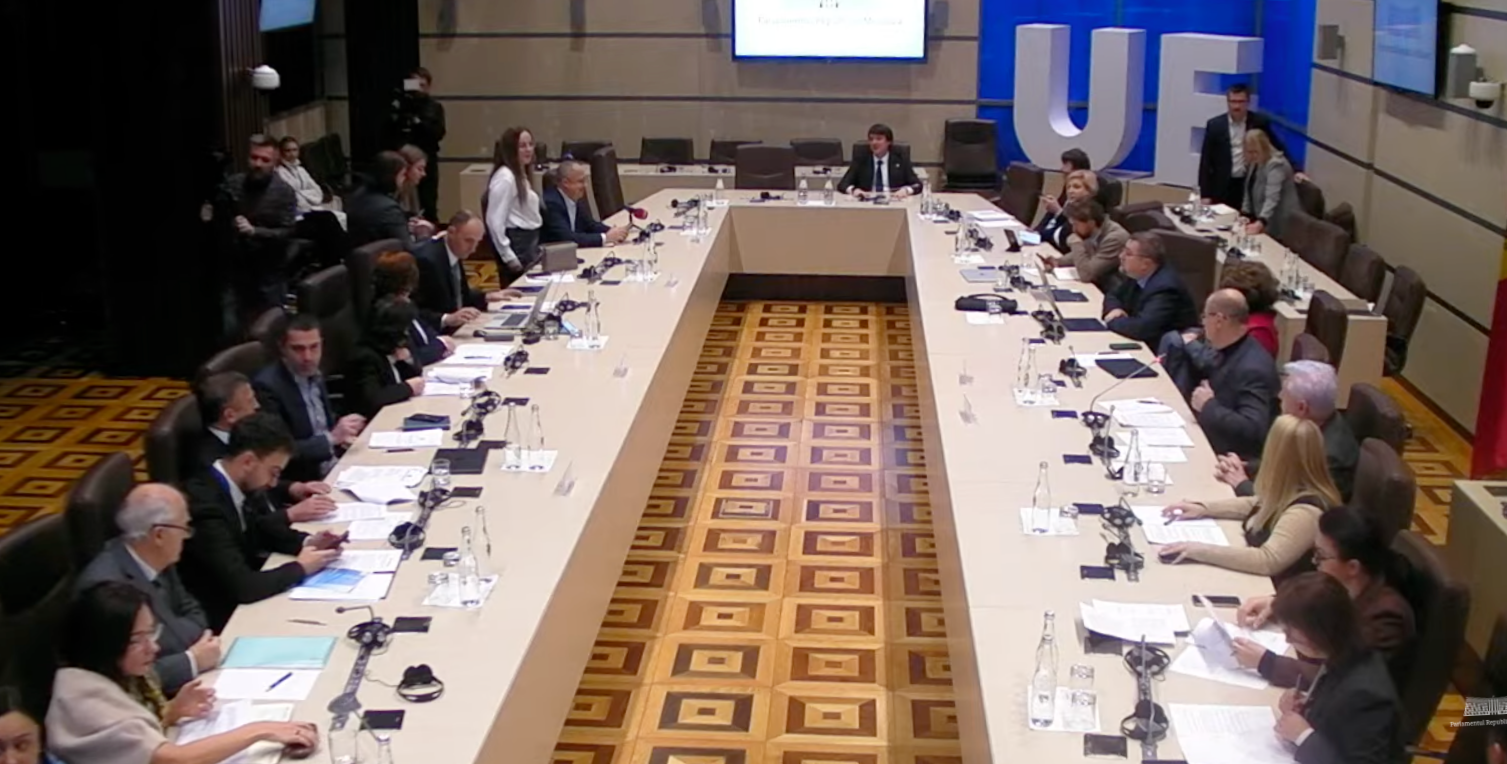
Parliament has taken note of the findings of the Court of Auditors regarding irregularities identified at Teleradio-Moldova (TRM) between 2023 and 2024 and will monitor how the public company implements the recommendations issued by the institution’s specialists. Hearings on the subject were held on December 3, and TRM has one year to remedy the non-conformities.
During the hearings organized by the Public Finance Control Committee and the Media Committee of the Legislature, Ion Sîrbu from the Court of Auditors listed the main findings of the audit report, which Media Azi has previously written about. He referred to a series of identified deficiencies, including the dual classification of TRM in the budgetary system, problems with accounting and management of public real estate assets, setting broadcasting tariffs, distribution of certain salary increases and bonuses, starting the process of finding new premises for the institution without following the procedures, and delays in digitizing the television and radio Golden Fund. “The company has been given 15 recommendations that we believe need to be addressed in the coming periods to ensure that the processes of formation, administration, and use of public financial resources and public assets are carried out in accordance with the applicable regulatory framework. We discussed these issues in several meetings, including at Teleradio-Moldova, the Ministry of Finance, and the Court of Auditors, in various formats. The recommendations were accepted and considered implementable,” said Ion Sîrbu.
In his speech, the Director General of TRM referred specifically to the irregularities and to each of the 15 recommendations, acknowledging that there are “vulnerable points and major problems” and that several discussions have already taken place, including within the Supervisory Board, “to put in order the priorities identified by the Court of Auditors and identify measures that would lead to the elimination of vulnerabilities.” “Consequently, we have developed an action plan that corresponds to the recommendations made to us by the Court and have extended them over a year. Some of the actions are to be implemented in the coming weeks and months, while others have a deadline of December 2026,” explained Vlad Țurcanu.
“The report contains issues that are beyond our competence, such as clarifying what Mr. Sîrbu referred to as the double classification of public institutions in the budgetary system. It is in the interest of Teleradio-Moldova to clarify these issues so that we, as an institution, can be sure that we are operating within a very clear framework, without any suspicions about its financial operations,” he said.
During the three hours of discussions, MPs from the ruling party and the opposition asked several questions to TRM management representatives and members of the Supervisory Board.
Some offered praise. “We need to see how things have evolved in the complicated conditions we find ourselves in today, (…) what state the studios were in, how the employees worked there. Now there is a huge difference. But, most importantly, people are talking about the quality of the services provided and the media programs at Teleradio-Moldova and appreciate these achievements,” said Marcela Adam.
Several opposition MPs were critical. Diana Caraman suggested that the Supervisory Board dismiss the “inefficient manager,” referring to Vlad Țurcanu. “There are many questions for you about how you allowed public money to be wasted, but at least in this way you are doing good for the country,” she said. Adela Răileanu and Vladimir Voronin requested that the Court of Auditors’ materials be forwarded to law enforcement agencies and that the Prosecutor General’s Office be notified. Alexandru Verșinin spoke of “obvious theft” and “serious violations related to public procurement,” the issue of outsourcing Eurovision and rebranding every two years. “Citizens are wondering if even one leu of public money is being stolen from this company. Either we pretend not to see these violations, or we must take action. I don’t want to believe that theft is taking place, but I have reasonable doubts that public money is being spent inefficiently,” the MP added.
Accusations of TRM’s political subordination have also been made. “I categorically reject these accusations. If you check the Audiovisual Council’s monitoring, especially during the election campaign, you will see that the opposition parties were given extensive coverage and there can be no assumption that Moldova 1 gave more airtime to the ruling party, either in the news, current affairs programs, or debates,” replied Andrei Zapșa, deputy director of TRM.
Opinions on the problems at TRM also differ among the members of the Supervisory Board.
Corneliu Popovici referred to the lack of transparency in the management of the company and public money and the lack of managerial professionalism. “TRM must be managed by professionals, by people who have managerial skills. And public money must be spent transparently. (…) There are many problems, and we are talking about a situation that has already existed for four years. People who, having been active for four years, have not noticed these problems identified by the Court of Auditors? Then they are either incompetent or had interests if they pretended not to see,” he said.
On the other hand, Loretta Handrabura invoked the interpretations that have been made in the public sphere. “The Court of Auditors’ exercise is a pertinent X-ray, which has developed and presented us with the real picture of things. (…) However, I am sure that these vulnerabilities will become priorities, and through this plan presented today, the members of the Council have made a collective and individual commitment. (…) Beyond political messages, we must be constructive and proactive in saying what works and what doesn’t, and where we must all take responsibility and respond when we make mistakes,” she said.
Vlad Țurcanu insisted that the institution he heads has the filters and powers to prevent unjustified spending and financial irregularities. “It is vital that the work of a public institution as important as Teleradio-Moldova is carried out correctly. We hope that the Court’s recommendations, as well as those concerning Parliament, will be implemented, including with the support of the Ministry of Finance, in order to eliminate ambiguities that allow for double interpretations,” concluded Liliana Nicolaescu-Onofrei, chair of the media committee, at the end of the meeting.