
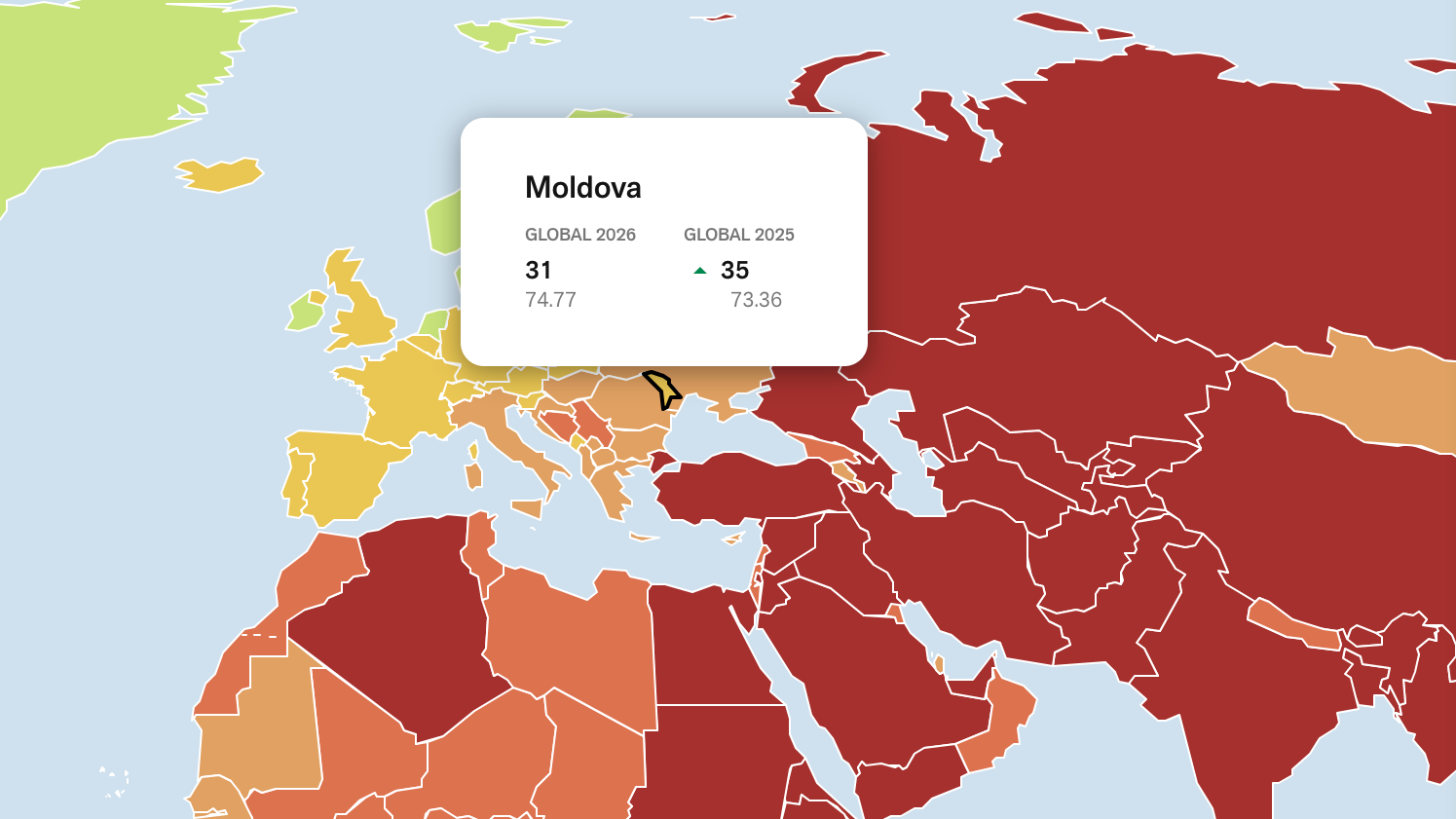
The Republic of Moldova has risen to 31st place, up from 35th in 2025, in the 2026 World Press Freedom Index published by Reporters Without Borders (RSF). The country remains the only one in Eastern Europe where the state of media freedom is classified as “satisfactory”. Moldova ranks ahead of countries such as Romania, in 49th place, Ukraine, in 55th, the United States, in 64th, and far above Russia, in 172nd place, one of the most restrictive countries for journalists. As in previous years, the ranking is led by Norway, followed by the Netherlands and Estonia.
Regarding Moldova, RSF notes that “the Republic of Moldova remains the only country in Eastern Europe classified as ‘satisfactory’ in terms of press freedom”. Experts point out that this position contrasts with the broader trend in Eastern Europe and Central Asia, where average press freedom indicators are declining, especially the legal indicator.
RSF largely maintains conclusions similar to those of last year: “Moldova’s media landscape remains polarised between pro-Russian and pro-Western camps, but the control exerted by oligarchs and political leaders over editorial policy has decreased in recent years.”
GLOBAL TRENDS
Global press freedom in 2026 has reached its lowest level in 25 years, the analysis shows. RSF notes that, for the first time in the history of the index, more than half of the world’s countries fall into the “difficult” or “very serious” categories in terms of the state of the media. This comes amid growing legislative pressure, the abusive use of national security laws and the increasingly frequent criminalisation of journalism. The organisation stresses that the legal indicator recorded the sharpest decline over the past year, signalling a global trend towards the restriction of the information space, including in some democratic states.
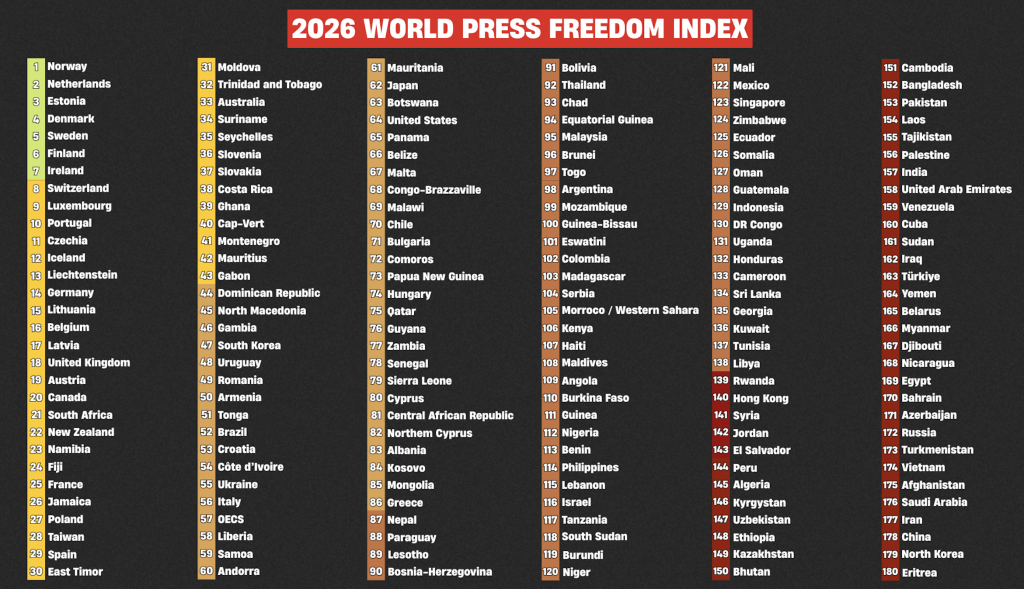

In 41 countries placed at the bottom of the ranking, working conditions for journalists remain critical, marked by repression, information control and systemic vulnerabilities. This category includes, among others, Hong Kong, ranked 140th, Syria, 141st, Jordan, 142nd, Algeria, 145th, Uzbekistan, 147th, as well as Ethiopia, 148th, and Kazakhstan, 149th. The lower part of the ranking is dominated by states where the press operates under severe constraints, including Russia, ranked 172nd, Turkmenistan, 173rd, Vietnam, 174th, Saudi Arabia, 176th, and Iran, 177th. The last positions are occupied by China, ranked 178th, North Korea, 179th, and Eritrea, 180th, where press freedom is virtually non-existent.
According to experts, more than 60% of countries are seeing a deterioration in the legal framework that protects the press. In some regions, such as the Americas, this decline is accompanied by increasing violence and political pressure on journalists. Against this backdrop, RSF warns that attacks on the right to information are becoming increasingly diverse and sophisticated, while the lack of effective protective measures risks accelerating the global decline of press freedom.
EU COUNTRIES: BETWEEN PROTECTING THE PRESS AND BREACHING EUROPEAN STANDARDS
Although press freedom and access to information in the EU are guaranteed by the European Media Freedom Act (EMFA), which entered into force in August 2025, several member states and candidate countries do not fully comply with these provisions, the assessment shows.
EMFA provisions guaranteeing the independence of public service media are being undermined both by existing regulatory frameworks and by draft legislation, particularly in Bulgaria, ranked 71st, Malta, 67th, Italy, 56th, Slovakia, 37th, France, 25th, Lithuania, 15th, and Czechia, 11th.
Estonia, ranked 3rd, whose public television and radio broadcaster has not been spared pressure, has lost its position as the EU leader to the Netherlands, ranked 2nd, the assessment indicates. In Hungary, ranked 74th, down six places, Viktor Orbán’s outgoing government refused to implement the EMFA, violated freedom of expression through the Sovereignty Protection Office — an instrument used to institutionalise the harassment of journalists — and politicised media regulation. The country is among the lowest-ranked EU states, alongside Cyprus, ranked 80th, and Greece, ranked 86th, where European legislation has failed to counter the “oligarchisation” of the media landscape and threats to journalists’ safety.
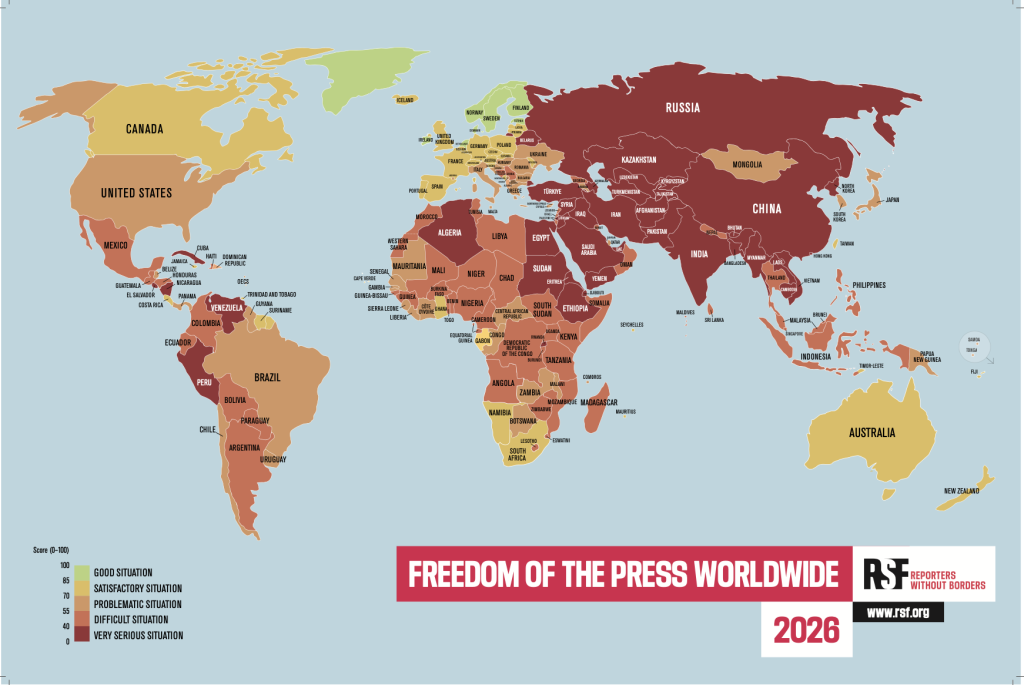

THE SITUATION IN EASTERN EUROPE AND CENTRAL ASIA
Eastern Europe and Central Asia remain among the most affected regions, ranking second to last globally.
In the Western Balkans, the situation is deteriorating in most countries: Albania, ranked 83rd, Bosnia and Herzegovina, 90th, and Serbia, 104th, are described as hostile to journalism and vulnerable to propaganda. Kosovo, ranked 84th, is a relative exception, having climbed 15 places.
The index also highlights significant declines in other countries in the region: Georgia fell to 135th place, down 21 positions, while Armenia, ranked 50th, was downgraded to the “problematic” category. At the same time, countries such as Belarus, ranked 165th, Azerbaijan, 171st, Russia, 172nd, and Turkmenistan, 173rd, are among the most restrictive in the world for the press.
THE AMERICAS: POLITICAL VIOLENCE AND SECURITY CHALLENGES
The figures show that the United States has fallen four places compared with last year, to 64th. “Despite improvements in recent years, as in the case of Brazil, ranked 52nd, recent developments in press freedom in the Americas have been marked by rising violence from two main actors: organised crime and political actors,” the document states. Experts say that “US President Donald Trump has turned repeated attacks on the press and journalists into a systematic policy.” At the same time, the assessment highlights that cuts in funding and staff at major international media outlets, such as Voice of America and Radio Free Europe, have affected access to information in several regions of the world.
In Latin America, several political leaders have adopted a tougher stance towards the press, leading to declines in the ranking for countries such as Argentina, ranked 98th, and El Salvador, ranked 143rd. Overall, these developments reflect growing political pressure on journalists and a deterioration in conditions for press freedom in the region, the assessment shows.