
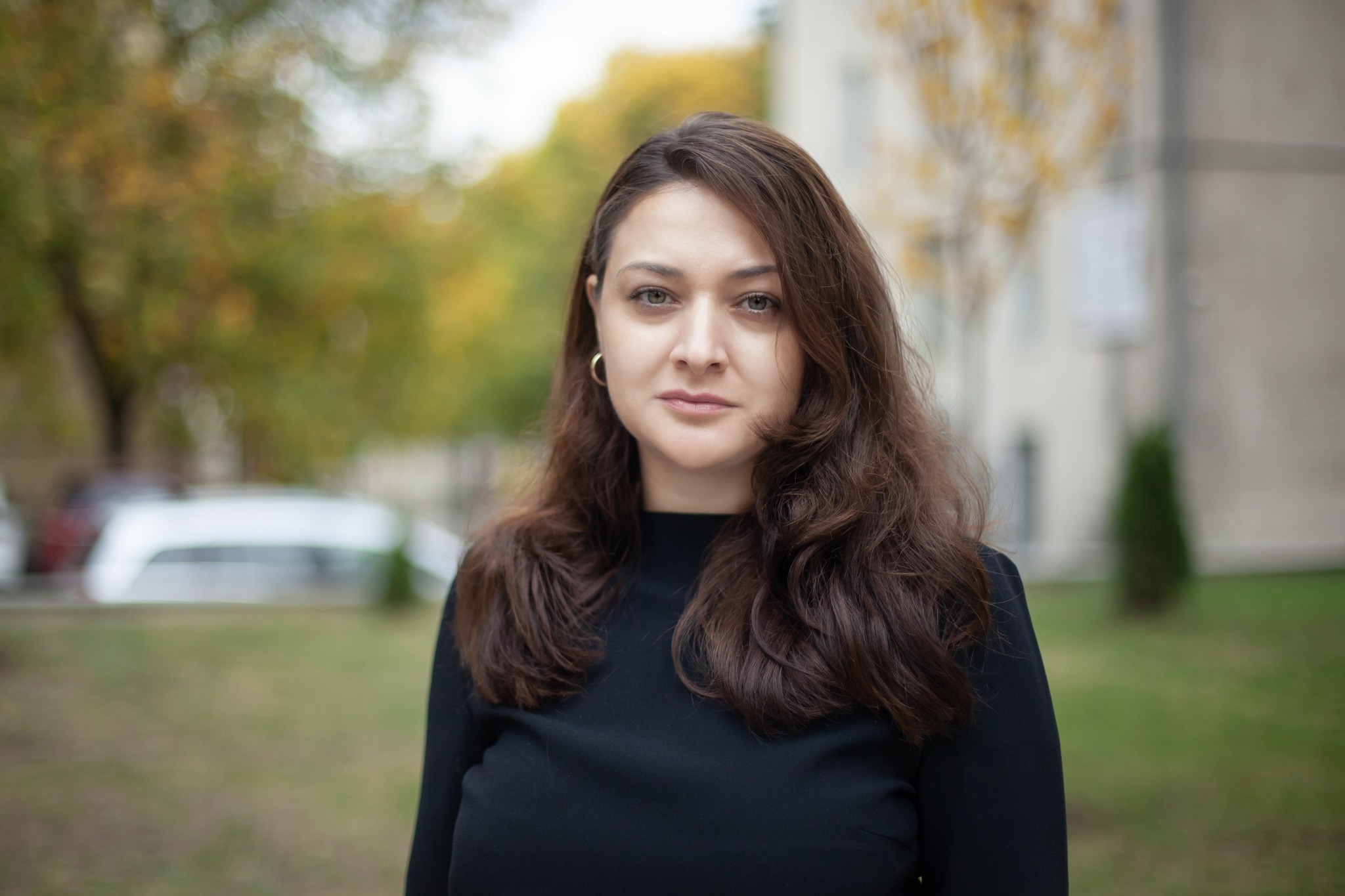
Anastasia Nani
In February, after a court hearing at the Supreme Court of Justice, the politician Igor Dodon left his coat in the arms of a female journalist. The MP seemed to think that this was a way of offering journalists a ‘guarantee’ that he would answer their questions.
Caught off guard, our colleague laughed. What followed? The debate about the case moved to social networks. In my bubble, I saw most people, including members of the profession, either laughing like the politician or criticizing the female journalist’s reaction. Those who condemned this humiliating gesture were fewer.
The situation reminded me of other local incidents involving female journalists and men holding certain positions, empowered to make decisions. Do you remember Vladimir Voronin who, after becoming an MP again in 2025, stuck his tongue out at a reporter? In that case too, most people found it amusing and moved on.
Dodon’s coat and Voronin’s protruding tongue took me back to my years as a reporter. There were many situations in which I was put ‘up against the wall’ simply because I was a young female reporter, some bordering on harassment, or perhaps crossing that line. There was a prosecutor who, during a meeting of the Superior Council of Prosecutors, allowed himself to invite me to a barbecue on the bank of the Nistru river. There was also Voronin who, when he saw you as a newcomer at Parliament, would enter your personal space and compliment you. Not to mention those who thought it acceptable to call at 2:00 in the morning. I have never found out what ‘valuable’ information they intended to share at that hour.
These incidents were not single cases, nor did they happen only to me. I am sure that every woman joining journalism has her own experience to share. It is not necessarily and not always for these reasons that female journalists come and leave the profession or move into the less visible part of it. The men who turn you into a coat-hanger, show you their tongues, or invite you to the riverbank, remain in positions of power, continuing similar behaviour with a new generation of female reporters.
After the coat incident, I asked myself: why didn’t Dodon put his coat in the arms of a male journalist? Would Voronin have stuck his tongue out at a man? Would the prosecutor have invited a male reporter to the bank of the Nistru river?
I doubt it. I doubt it in the context of the Republic of Moldova.
I don’t want to suggest that our male colleagues don’t face challenges. There have been many cases where boys and men in journalism have been threatened, insulted, or even physically attacked. What I mean is that they encounter less often those situations that (seem to) make people smile, that (seem to) be funny, that (seem to) be offensive, and that (seem to) resemble sexual harassment, but SOMEHOW not quite enough to justify a complaint or a public reaction. In the public sphere, reactions are usually considered legitimate only when things get serious. Reactions are supported when a female journalist is attacked at protests or threatened with death. In these situations, it’s understandable, isn’t it?
A recent report by the Council of Europe, released in early March 2026, confirms that online violence and gender-based threats pose a risk to female journalists in Europe. According to the research, up to 87% of female journalists reported experiencing online violence related to their professional activity. And yes, the report also notes that female journalists face a ‘double risk’: they are targeted both for their work and for their gender, and the level of harassment can push some of them to less visible roles or even to leave the profession.
The verb ‘to attack’ may seem exaggerated in the context of the situations described above. But the frequency and tolerance of such incidents turn them into a phenomenon.
Regardless of whether we are talking about a serious incident, an inappropriate gesture, or an inappropriate compliment — what do female journalists actually want? In several private conversations, my female colleagues insist on respect from politicians (whether MPs or not), ministers or mayors, prosecutors or judges, security guards or market vendors, etc.
A female journalist wants to be treated as a professional, without having her role diminished by being called ‘sweetie,’ ‘cutie,’ or ‘little girl,’ without remarks like ‘you chose the right dress colour today’ or ‘smile more.’ At the beginning of your career, such comments can be discouraging and make you give up on certain journalistic pursuits. Immunity develops over time, but for some – only after they retreat behind the scenes of their profession or leave it.
Many of the sources listed above have codes of ethics, and if they haven’t written in black and white about decent behaviour towards the press, they should cultivate their own code with common sense rules. If they don’t even have common sense, then maybe it would help them to ask themselves a simple question: how would I want my daughter to be treated if she chooses to become a journalist?
On the other hand, I think that editorial offices should also ‘inject’ a dose of confidence into their own employees and make a list of response rules for situations that (seem to) make people smile, that (seem to) be funny, that (seem to) be offensive, and that (seem to) resemble sexual harassment and in which it is OBVIOUS that it is appropriate to notify your superiors and colleagues, or even respond publicly.
Each newsroom can develop its own set of rules and establish simple guidelines: what is considered inappropriate behaviour from sources, and how both female and male journalists should react. For example, a journalist is not obliged to tolerate humiliating or sexualized gestures; they may interrupt the interaction; they can notify the management of the editorial office, who can then decide whether a public response is necessary.
Going back to the coat incident: a female journalist caught off guard may react in many ways. What matters is that the profession responds appropriately. And more experienced colleagues—including those who witnessed the situation—can firmly say what should be obvious: female journalists (and male journalists) are not coat-hangers! It is also the role of the profession to ensure that such behaviour does not become normal.
The article was written within the project “Resilient Media, Informed Voters: Safeguarding Moldova’s Elections from Disinformation”, funded by the Embassy of the Kingdom of the Netherlands in Moldova. The views expressed are those of the authors and do not necessarily reflect the position of the donor.