
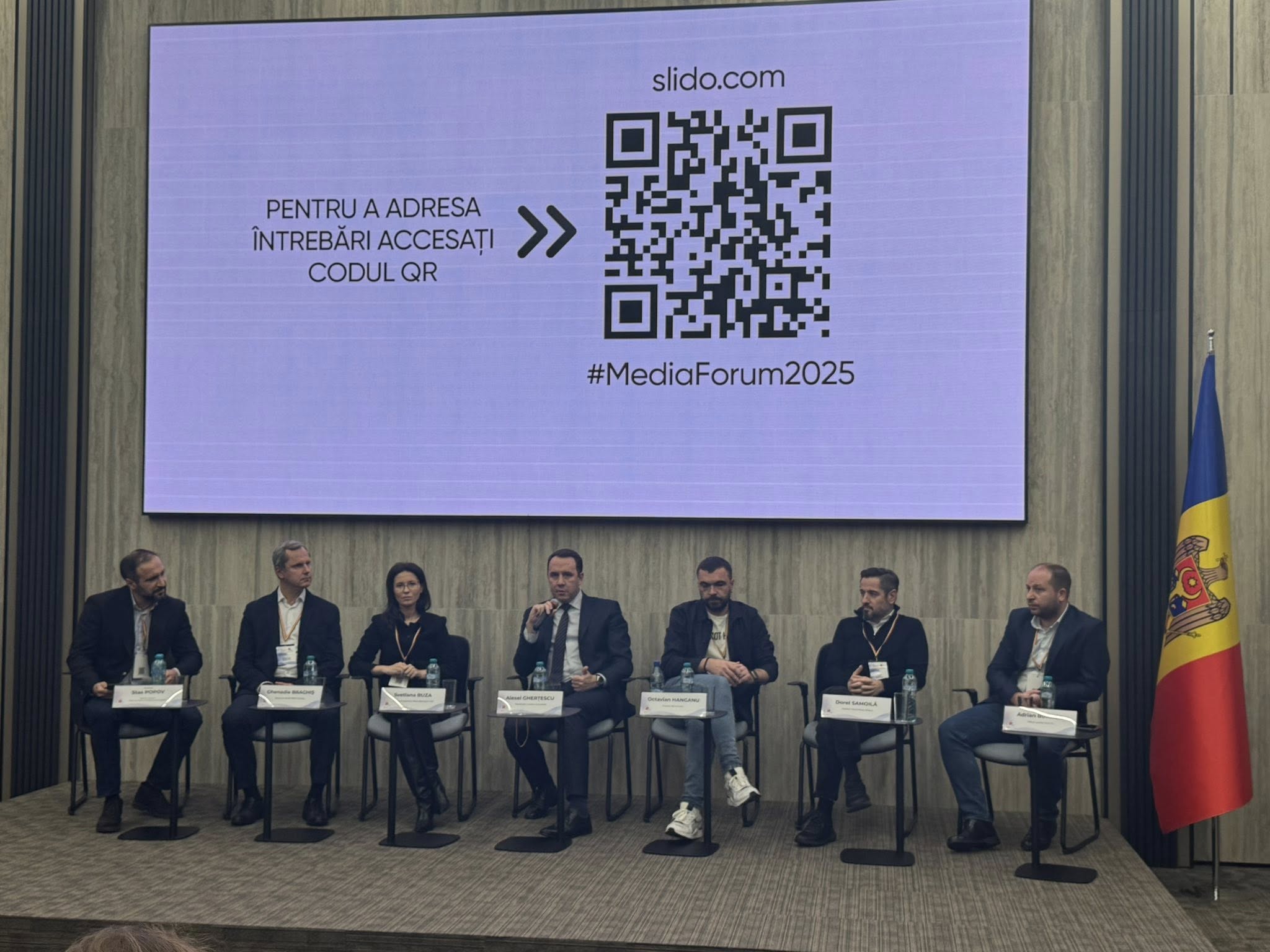
In the Republic of Moldova, there is a significant gap between the written rules of the advertising market and media reality. Although the new legislation has set clear guidelines on fair competition, consumer protection, and transparent relations between producers, suppliers, and beneficiaries, the authority responsible for enforcing these rules does not have sufficient resources to monitor the situation. These conclusions, as well as the main problems in the media advertising market, were addressed at the Media Forum in the Republic of Moldova, during the debate “The advertising market: written rules versus unwritten practices.”
The panel identified several issues affecting the media advertising ecosystem, namely: the migration of budgets to the online environment, the fragmentation of the audience across multiple screens, and price discrepancies between high-rating stations and independent television stations. “Our analyses show a substantial increase in online advertising and sales over the last two to three years,” noted Alexei Gherțescu, president of the Competition Council, emphasizing that the trend is not only local but part of a global phenomenon.
On behalf of the media industry, Octavian Hanganu, founder of Media Division, presented a financial analysis showing a gap between market potential and reality. In relation to Gross Domestic Product, the television market should have reached around €77 million, but actual revenues do not exceed €25 million, and effective advertising is worth only about €10 million. He explained that although the market is free and TV inventory can be supplemented by online options, media consumption has diversified: “It is no longer the consumption of a single screen, but the consumption of all screens.” The solution that the expert sees for local media providers is to diversify the platforms on which they are present with content in order to recover dispersed audiences.
Dorel Samoilă, founder of Publicis Media Moldova, emphasized the main objective of advertising companies: finding the right audience. He gave an example: out of 100 people in commercial groups, traditional commercial stations cover approximately 45% of the 18+ audience nationally, leaving 55% who watch channels on which advertising cannot be placed. “When advertisers can’t find their audience on those channels, they’ll look elsewhere,” he said, explaining why budgets are moving to digital.
Ghenadie Braghiș, sales director at ProTV Chișinău, pointed out that the growth prospects for TV advertising are limited both nationally and globally. He pointed to the need for better audience measurement—a credible data provider that could boost the TV market with more solid figures and a clearer picture for advertising companies.
Svetlana Buza, executive director of TV8, drew attention to another distortion: the large differences in pricing between television stations. “It is not possible for a television station with the highest ratings to sell three times cheaper than an independent television station,” she said, noting that independent television stations make great efforts to ensure editorial fairness and commercial sustainability, but struggle with market prices that undermine their capacity for investment and development. In addition, Buza mentioned that another problem is the ability of the public television station Moldova 1 to sell advertising, which affects the entire market. In an already constrained and very small context, a significant part of the total market budget is absorbed by Moldova 1, an issue that, according to her, should be reviewed together with the responsible institutions.
Adrian Buraga, general director of Jurnal TV, pointed out the problem of the absence of a solid market for political advertising, which traditionally can supplement the revenues of stations during election periods. “I would like to see more political advertising in the Republic of Moldova, but it practically does not exist. Every time we enter an election campaign, we recognize that, from a commercial point of view, we also expect political advertising. Unfortunately, based on our experience in recent years, this is very modest. We are well aware of our social responsibility and the impact we have on society, but let’s not forget the economic side, which is important for a media manager,” said Buraga, noting that discussions with parliamentary committees on advertising regulation have taken place, but the legal framework remains insufficient to respond to new realities.
“We have been discussing the need for greater regulation in this area for several years,” said the president of the Competition Council. Gherțescu explained that competition authorities, which are generally in favor of market liberalization, must accept that when systemic problems arise, “we must not be afraid of the word ‘regulation.'” He proposed the idea of regulations that would ensure the allocation of advertising slots for domestic products, so that advertising budgets do not converge exclusively on foreign content or series that attract a massive audience.
Media Azi previously wrote about the fact that Kantar Media is the audiovisual audience measurement company, designated the winner on March 29, 2024, which requested €1.8 million annually to measure audience shares in the Republic of Moldova. At that time, representatives of the commission that selected the measurement company indicated that it would take some time for Kantar Media to enter the market, the main reason being the excessively high financial offer. Therefore, until solutions were identified and the actual measurements began, television stations continued to use the services of the company that had previously operated in the market – TV MR MLD (the official representative of AGB Nielsen Media Research).